
How to Grow Zinnia from Seed in Malaysia (Pots and Gardens)
How to grow zinnia in Malaysia: sowing, pinching for more flowers, watering in humid weather, preventing powdery mildew, pests and cutting blooms.
- Difficulty
- Easy
- Days to harvest
- 50–70 days
- Updated
- 2026-11-04
Yes — zinnia (bunga zinnia, 百日草) grows very well in lowland Malaysia. It is a heat-loving annual that sprouts in a few days and usually starts flowering about 7–10 weeks after sowing, then keeps going for weeks if you keep cutting the blooms. The one tip that matters most in our climate: give each plant space and airflow and keep water off the leaves, because powdery mildew is the zinnia's main enemy in humid weather.
Quick facts
| Item | Zinnia |
|---|---|
| Sun | Full sun, 6 hours or more |
| Sowing depth | About 0.5–1 cm |
| Germination | 3–7 days |
| Spacing | Dwarf types: 20–25 cm; tall types: 30–40 cm |
| Days to first flowers | About 50–70 (dwarf types are quicker) |
| Container | Dwarf: 15–20 cm pot; tall: 25–30 cm pot or large polybag |
| Support | Tall types: a stake or string support in windy spots |
Which zinnia to grow
- Tall, large-flowered types (often sold as "giant" or "dahlia-flowered") grow about 60–100 cm high with big double blooms. Best for cut flowers and garden beds.
- Dwarf and bedding types stay around 20–40 cm and suit balcony pots and window boxes.
- Narrow-leaf zinnia (Zinnia angustifolia) and its hybrids have small flowers on low, spreading plants and are generally much more resistant to powdery mildew. If your garden is humid and sheltered, these are worth trying.
Choosing a spot and container
Zinnias need strong sun and moving air. A sunny balcony railing, an open patch of a terrace-house yard or a rooftop is ideal. Avoid tight corners against walls, where air sits still and leaves stay damp — exactly the conditions mildew likes.
Use pots with drainage holes. One dwarf zinnia fits in a 15–20 cm pot; a tall one needs a 25–30 cm pot so it does not blow over. Do not crowd several plants into one small pot.
Soil and potting mix
Zinnias like a loose, fertile mix that drains well:
- 2 parts potting mix or loose garden soil
- 1 part compost
- 1 part burnt rice husk (sekam bakar), perlite or coarse sand
A handful of compost is plenty. Too much nitrogen makes soft, leafy growth that catches mildew more easily.
How to sow zinnia step by step
- Choose where to sow. Zinnias grow best when sown directly where they will flower, or in individual small pots. They dislike having their roots disturbed.
- Prepare the mix. Fill the pot and water it until it drains.
- Sow. Push 2–3 seeds about 0.5–1 cm deep per spot. Zinnia seeds are flat and arrow-shaped; lay them flat.
- Cover and firm gently.
- Keep moist, not soaked. Seedlings appear quickly, often within 3–7 days.
- Thin. When seedlings have their first true leaves, snip off the weaker ones at soil level, leaving one per spot.
If you start them in a tray, transplant early — when seedlings have 2 pairs of true leaves — and handle them by the leaves, not the stem.
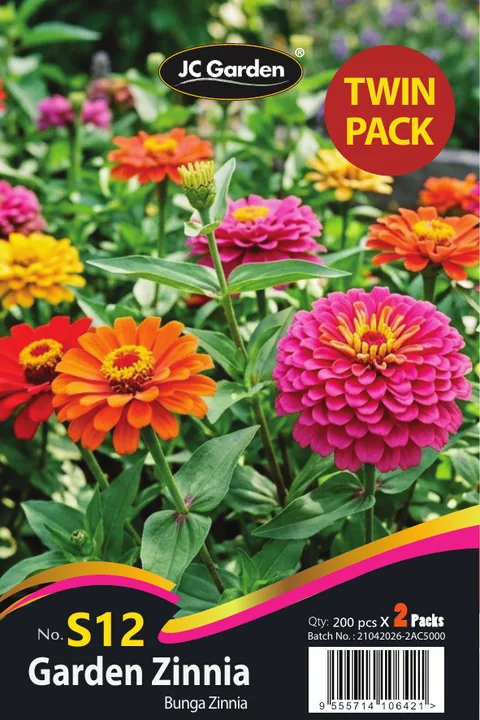
Garden Zinnia Seeds
Bright, heat-loving zinnia that sprouts in days — cut the flowers and more keep coming.
Pinching and support
Pinching is the secret to a bushy zinnia with many flowers. When a young plant has 3–4 pairs of leaves, cut off the top just above a pair of leaves. Two side shoots grow from that point, and each one will flower. The first bloom comes a little later, but you get far more stems overall.
Tall types can flop in a storm. Push a bamboo stake into the pot at planting time and loosely tie the main stem, or run garden string around a few canes to hold a group of plants upright.
Watering in hot and humid weather
- Water at the base, in the morning, so the leaves stay dry and the soil has the day to dry slightly. Avoid evening watering over the leaves.
- In hot, dry spells, water when the top 2 cm of mix is dry; pots in full sun may need water daily.
- In the rainy season, skip watering when the mix is still damp. Zinnias tolerate rain, but they rot in waterlogged pots.
Feeding
Mix compost into the potting mix before sowing. Once plants are about 15 cm tall, give a balanced liquid fertilizer every 2 weeks at the label rate. When buds appear, a feed slightly higher in potassium supports flowering. Feed lightly rather than heavily.
Powdery mildew and other problems in Malaysia
- Powdery mildew. White, flour-like patches on the leaves, starting with the lower, older leaves. It spreads in warm, humid weather with little air movement and is very common on zinnias. To prevent it: space plants well, water the soil not the leaves, remove lower leaves that touch the soil, and grow resistant types where possible. Once you see it, remove the worst leaves and spray the rest with neem oil or a mild baking-soda solution every 7 days, testing on a few leaves first. Mildew rarely kills the plant outright, but it weakens it.
- Leaf spot. Brown or dark spots with yellow edges, worse in long rainy spells. Remove spotted leaves and improve spacing.
- Aphids and thrips. Distorted buds and streaky petals. Spray with water, then neem oil.
- Caterpillars and beetles. Holes in petals and leaves. Hand-pick at dusk.
- Spider mites. Fine yellow speckling in hot, dry weather. Spray leaf undersides with water and neem oil.
- Stem rot. Wilting at the base after waterlogging. Improve drainage; remove dead plants.
More organic solutions:
Cutting flowers and deadheading
Zinnias are a "cut-and-come-again" flower: the more you cut, the more they bloom. Cut stems in the morning, just above a pair of leaves, so two new shoots form.
To check if a cut zinnia is ready, hold the stem about 20 cm below the flower and shake gently. If it stays upright, it is ready; if it bends, wait a few more days. In a vase, change the water daily.
Remove faded flowers on plants you are not cutting from. When a plant is tired and covered in mildew, pull it out and sow a fresh batch — sowing small batches every 3–4 weeks gives non-stop colour.
Saving seed
Let a few healthy flowers dry completely on the plant until the head turns brown. Pull apart the head; the seeds are at the base of the petals. Dry them in the shade and store them somewhere cool and dry. Seed from hybrid varieties may not come true.
FAQ
Why are my zinnia leaves white and dusty? That is powdery mildew. Improve airflow, water the soil only, remove the worst leaves, and consider mildew-resistant types for your next sowing.
Do zinnias attract butterflies? Yes, they are a favourite of butterflies and bees, which makes them useful near vegetable plots.
Can zinnias grow on a shady balcony? They grow, but with fewer flowers and more mildew. With less than about 5 hours of direct sun, choose a more shade-tolerant flower such as balsam:
What grows well alongside zinnia? Marigold and cosmos like the same sunny conditions: