
How to Grow Cosmos Flowers from Seed in Malaysia
How to grow cosmos in Malaysia: yellow-orange and pink types, sowing in poor soil, why not to overfeed, staking, watering, pests and self-seeding.
- Difficulty
- Easy
- Days to harvest
- 45–70 days
- Updated
- 2026-11-04
Yes — cosmos (bunga cosmos, 波斯菊) is one of the most carefree flowers for lowland Malaysia. It sprouts fast, tolerates heat, and usually starts flowering about 7–10 weeks after sowing; the yellow-orange types are often quicker. The one tip that matters most: do not pamper it. Cosmos flowers best in plain, even poor, soil with little fertilizer — rich soil and heavy feeding give tall, leafy, floppy plants with few flowers.
Quick facts
| Item | Cosmos |
|---|---|
| Sun | Full sun, 6 hours or more |
| Sowing depth | About 0.5 cm |
| Germination | 4–10 days |
| Spacing | 25–40 cm, depending on type |
| Days to first flowers | About 45–70 |
| Container | 20 cm pot for compact types; 25–30 cm pot or large polybag for tall types |
| Support | Tall types: a stake in windy or rainy spots |
Which cosmos to grow
- Yellow-orange cosmos (Cosmos sulphureus) — orange, yellow or red-orange flowers, usually 40–100 cm tall depending on variety. Very heat-tolerant and a common sight in Malaysian gardens and roadsides. Dwarf varieties suit pots.
- Garden cosmos (Cosmos bipinnatus) — the classic pink, white and magenta flowers with fine, feathery leaves. Often 90–150 cm tall, so better in the ground or in big pots, with support. It grows in the lowlands too, but plants can flop in heavy rain.
You may know ulam raja (Cosmos caudatus), the leafy herb eaten as ulam. It is a close relative, but the ornamental cosmos in this guide are grown for flowers, not as a vegetable. Only eat a plant you can identify with certainty.
Choosing a spot and container
Give cosmos the sunniest place you have. In shade it stretches, leans towards the light and flowers poorly. On a balcony, choose dwarf yellow-orange types and a spot sheltered from the strongest wind. In a terrace-house yard, cosmos is ideal for a sunny strip along a fence or the edge of a vegetable bed, where it brings in bees and butterflies.
Use pots with drainage holes. One compact plant fits a 20 cm pot; tall types need a 25–30 cm pot, or plant them in the ground.
Soil and potting mix
This is where cosmos is different from most flowers:
- Use ordinary garden soil or plain potting mix with a little sand or burnt rice husk (sekam bakar) for drainage.
- Skip the manure and extra compost. A small amount of compost is fine in very poor, sandy soil, but nothing more.
- Good drainage matters more than richness. Cosmos dislikes sitting in water.
How to sow cosmos step by step
- Sow where it will grow if you can. Cosmos grows quickly and transplants best when young, so direct sowing in the final pot or bed is easiest.
- Prepare the soil. Loosen it, level it and water it.
- Sow. Place 2–3 of the long, thin seeds per spot, about 0.5 cm deep, at the spacing in the table.
- Cover lightly and firm.
- Keep moist. Water gently each day until seedlings appear, usually in 4–10 days.
- Thin. Keep the strongest seedling at each spot once they have a few true leaves.
To start in a tray, sow one or two seeds per cell and transplant when seedlings have 2–3 pairs of true leaves.
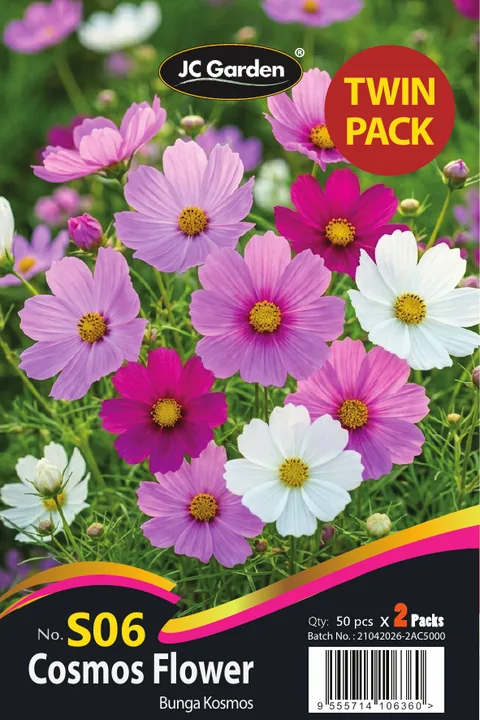
Cosmos Flower Seeds
Carefree, heat-tolerant cosmos that flowers best in plain soil with little fertilizer.
Pinching and support
When plants are about 30 cm tall, pinch out the top just above a pair of leaves. This makes the plant branch, gives more flowers and keeps it a little shorter and sturdier.
Tall types can be knocked flat by tropical storms. Put a bamboo stake in at planting time and tie the main stem loosely as it grows, or plant several close together so they hold each other up. If a plant falls over, it often bends up again from the base, but stems may snap.
Watering in hot and rainy weather
Once established, cosmos copes with short dry spells better than most flowers. Water when the top few centimetres of soil are dry — pots in full sun may still need water most days in a hot spell. Water at the base, in the morning.
In the rainy season, the main risk is waterlogging and flopping. Do not water if the soil is still wet, keep drainage holes clear, and check stakes and ties after a storm.
Feeding
Usually, none. In ordinary soil, cosmos needs no regular fertilizer. Only if plants are pale, small and slow in a very sandy or exhausted mix, give one light, half-strength liquid feed with more potassium than nitrogen. Too much nitrogen means more leaves, fewer flowers and weaker stems.
Common pests and diseases in Malaysia
- Aphids. Clusters on buds and stem tips. Spray off with water, then neem oil or a mild soap solution.
- Thrips. Streaky, damaged petals and distorted buds. Neem oil sprays every 5–7 days in the evening help.
- Caterpillars. Holes in leaves and petals. Hand-pick at dusk.
- Powdery mildew. White patches on leaves in humid, crowded plantings. Space plants and remove affected leaves.
- Stem rot and wilting. Usually from waterlogged pots. Improve drainage and avoid overwatering.
- Snails. They eat young seedlings after rain. Pick them off at night.
More organic solutions:
Deadheading and cutting flowers
Cut off faded flowers to keep the plant blooming for longer. Snip the stem back to the next bud or leaf pair. For a vase, cut flowers in the morning when they are just opening; they last a few days.
Self-seeding and saving seed
If you leave some flowers to mature, cosmos drops its seeds and new seedlings often pop up by themselves. Yellow-orange cosmos self-seeds especially freely — pull out seedlings where you do not want them.
To save seed, leave a few heads until they turn brown and the dark, needle-like seeds come off easily. Dry them in the shade and store them somewhere cool and dry.
FAQ
Why is my cosmos tall and leafy with few flowers? Usually too much fertilizer, rich soil, or not enough sun. Stop feeding, pinch the tips and move pots to a sunnier spot. Sow the next batch in plainer soil.
How long does cosmos keep flowering? With deadheading, often several weeks to a couple of months. Sow a new batch every 4–6 weeks for continuous colour.
Can I grow cosmos on a condo balcony? Yes — choose dwarf yellow-orange varieties, a sunny spot and a pot heavy enough not to tip in the wind. Our balcony guide helps with sun and wind:
What grows well with cosmos? Marigold and zinnia enjoy the same full sun: