
How to Grow Winter Melon (Kundur) at Home in Malaysia
How to grow winter melon (kundur, 冬瓜) in Malaysia: soaking seeds, para or ground growing, morning hand-pollination, fruit flies and harvesting.
- Difficulty
- Medium
- Days to harvest
- 90–120 days
- Updated
- 2026-11-05
Yes — winter melon (Benincasa hispida, kundur in Malay, 冬瓜 in Chinese) grows well in lowland Malaysia. It enjoys our heat and sun. Young, hairy fruit can be picked for soup a couple of weeks after they set, and mature fruit with the classic white, waxy coating are usually ready about 90–120 days from sowing. It is a big, vigorous vine, so plan for space: an overhead para, a strong trellis or a patch of ground. The one key tip: the yellow flowers open early in the morning, so if young fruit keep turning yellow and dropping, hand-pollinate before about 9 am — and bag every fruit you want to keep against fruit flies.
Quick facts
| Item | Winter melon |
|---|---|
| Sun | Full sun, 6–8 hours |
| Sowing depth | 2–3 cm; soak seeds 12–24 hours first |
| Germination | 5–10 days, sometimes up to 2 weeks |
| Spacing | 1–1.5 m apart on a para; about 2 m apart if sprawling on the ground |
| Days to harvest | Young fruit about 2–3 weeks after fruit set; mature fruit about 90–120 days from sowing |
| Container | Large polybag or tub, at least 50–60 litres of mix and 40 cm deep; the ground is better |
| Support | Strong para or trellis about 2 m high, or open ground with mulch |
Choosing a spot and container
Winter melon needs full sun and room to run. In a terrace-house yard, the best place is the side of the house or a car-porch frame where you can build an overhead para of bamboo, PVC pipe or steel with netting on top. The vine covers the top and the fruit hang underneath, clean and off the ground. In an open garden it can also sprawl on the ground like a pumpkin.
It is not a natural condo-balcony crop. One plant in a large polybag can work on a sunny rooftop or big balcony with a sturdy frame, but fruit and wet soil are heavy. Check what your balcony can carry:
Soil
Winter melon is a heavy feeder and drinks a lot. Prepare a planting hole or container with:
- 2 parts garden soil or potting mix
- 1 part compost or well-rotted chicken or cow manure
- 1 part burnt rice husk (sekam bakar) or coarse sand for drainage
- A handful of dolomite lime if your soil is acidic, mixed in a week or two before planting
In the ground, dig a hole about 50 cm wide and deep, refill with this mix and build a low mound so rain drains away from the stem.
How to sow winter melon step by step
- Soak the seeds. The seed coat is hard. Soak seeds in room-temperature water for 12–24 hours. For seeds that stay flat and hard, carefully nick the edge of the coat (away from the pointed end) with nail clippers.
- Choose where to sow. Sow where the plant will grow, or in 10–15 cm pots to protect seedlings from snails and heavy rain.
- Sow. Push 2–3 seeds per spot about 2–3 cm deep, cover, firm gently and water well.
- Keep moist, not soggy. Seedlings usually appear in 5–10 days; waterlogged seed rots.
- Thin. When seedlings have 1–2 true leaves, keep the strongest one per spot and snip the others at soil level.
- Transplant early. Plant out pot-raised seedlings at 2–3 true leaves, handling them by the root ball.
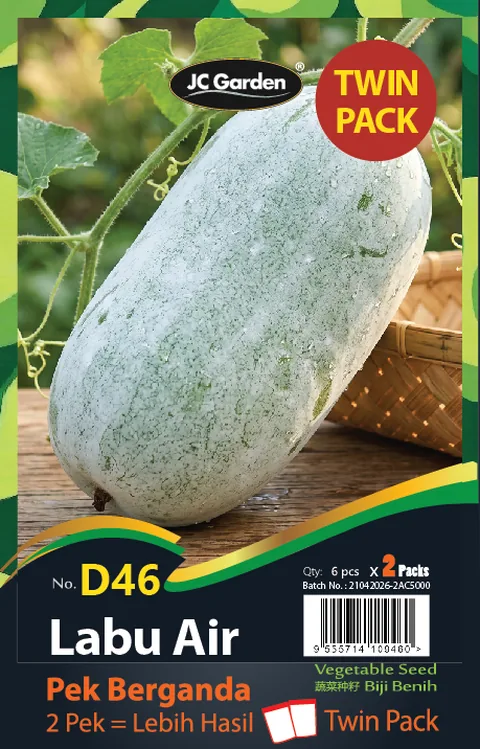
Winter Melon Seeds
JC Garden seed twin pack (2 packets). See the pack for sowing details.
Para, training and pruning
Build the support within 2–3 weeks of germination, before the vine runs.
- Guide the main vine up a bamboo pole or string to the top of the para. Tie it loosely with soft ties; the tendrils will do the rest.
- Remove side shoots that grow below the para, so energy goes up.
- When the main vine reaches the top (around 1.5–2 m), pinch out its tip so strong, free-flowering side shoots spread across the para.
- Keep 2–4 strong side shoots and trim weak, crowded ones for airflow.
On the ground, let the vine sprawl over dried leaves or straw, with a board or tile under each fruit to keep it off wet soil.
Mature fruit get very heavy. On a para, support each one with a net bag or cloth sling tied to the frame so the stalk does not tear.
Flowers and pollination
Each plant has separate male and female flowers. Males usually appear first; females have a small, hairy baby fruit behind the petals. The yellow flowers open early in the morning and attract bees.
If bees are scarce, hand-pollinate before about 9 am: peel the petals off a fresh male flower and rub its pollen onto the centre of a female flower. Pollinated fruit swell within days; unpollinated ones turn yellow and drop.
For large mature fruit, keep only 1–2 per plant and remove the rest while small. If you pick young fruit, the plant can carry more.
Watering in hot and rainy weather
- Hot spells: water deeply at the base in the morning; container plants may need water daily, sometimes twice. Mulch keeps the soil moist and cool.
- Fruit growth: keep moisture steady while fruit swell. Drought followed by heavy watering can split or deform fruit.
- Rainy season: make sure the mound or container drains well, keep fruit off wet soil and remove rotting leaves at the base. Avoid wetting leaves late in the day.
Feeding
- Mix compost or manure into the soil at planting.
- From about two weeks after germination, give a small dose of balanced fertilizer (such as NPK 15-15-15) every 2–3 weeks, following the label and keeping granules off the stem.
- When flowering starts, switch to a fertilizer with more potassium to support fruit, and top-dress with compost.
- Too much nitrogen gives a jungle of leaves and few fruit.
Common pests and diseases in Malaysia
- Melon fruit flies. The biggest problem: they lay eggs in young fruit, which then rot or twist. Wrap each fruit in a paper or fine mesh bag as soon as it sets, closed around the stalk with a small drainage opening at the bottom. Collect fallen fruit and hang fruit fly traps a little away from the vine.
- Red pumpkin beetle. Orange beetles that chew round holes in leaves, worst on young plants. Hand-pick in the cool early morning and cover seedlings with netting.
- Aphids, whiteflies and thrips. Curled or speckled leaves. Spray diluted neem oil in the evening, covering leaf undersides.
- Powdery and downy mildew. White powder or yellow, angular leaf patches, worse in humid weather. Prune for airflow, water at the base and remove badly affected leaves.
- Wilting vines. Sudden wilting in moist soil may be a soil-borne wilt. Remove the plant and rotate gourds to another spot.
Harvesting
There are two ways to harvest winter melon:
- Young fruit: about 2–3 weeks after fruit set, while still hairy and tender. Cook them fresh; they do not keep long.
- Mature fruit: leave the fruit on the vine until the hairs fall away, the skin hardens and a white, powdery wax covers it. This is usually about 90–120 days from sowing, depending on variety and weather. Cut the fruit with a few centimetres of stalk using clean shears.
Handle mature fruit gently and do not wash off the wax. A sound fruit with its wax intact stores for a long time in a cool, dry, shaded place. Once cut, wrap it and refrigerate.
FAQ
Is winter melon the same as bottle gourd? No. Both are sometimes called "labu air" in Malay, which causes confusion. Winter melon (kundur, 冬瓜) has a waxy white skin when mature; bottle gourd (蒲瓜) has smooth green skin and white flowers that open at dusk.
Why do my baby fruit turn yellow and fall off? Usually poor pollination. Hand-pollinate in the early morning, and make sure the plant is not short of water or food.
What else grows well on a para? Other gourds, for example: