
How to Grow Loofah (Petola) at Home in Malaysia
How to grow loofah (petola, sponge gourd) in Malaysia — angled and smooth types, trellis, hand pollination, fruit fly bagging and picking young.
- Difficulty
- Easy
- Days to harvest
- 50–70 days
- Updated
- 2026-11-04
Yes — loofah (petola, also called sponge gourd) is one of the easiest and most vigorous gourds for lowland Malaysia. It thrives in heat and rain, and the first young fruit are usually ready about 50–70 days after sowing. Both common types are eaten young: the angled loofah (petola segi) with sharp ridges, and the smooth loofah (petola) with a round, smooth skin. The one key tip: pick them young and tender. Within days a loofah turns fibrous — left long enough on the vine, it becomes a bath sponge instead of dinner.
Quick facts
| Item | Loofah (petola) |
|---|---|
| Sun | Full sun, 6–8 hours |
| Sowing depth | About 2 cm; soak seeds 12–24 hours first |
| Germination | 5–10 days |
| Spacing | 60–90 cm between plants along a trellis |
| Days to harvest | About 50–70 days from sowing to first young fruit |
| Container | At least 30–40 L per plant, 40 cm deep |
| Support | Yes — a strong trellis or overhead para about 2 m high |
Choosing a spot and container
Loofah is a big, fast vine. It can easily cover 3–4 m of fence or a whole overhead para in a terrace-house yard, giving shade underneath as a bonus. An overhead frame is ideal because the fruit hang straight down and grow evenly. On a balcony, one plant in a large pot with a net up to the ceiling is usually enough — be ready to train and trim it so it does not swallow the railing.
Use a 30–40 L polybag or pot per plant. A large pot full of wet soil is heavy, so check your balcony before placing several:
Soil and potting mix
Loofah grows in most soils as long as they drain. A good container mix:
- 2 parts garden soil or potting mix
- 1 part compost or well-rotted manure
- 1 part burnt rice husk (sekam bakar) or cocopeat
Add a handful of compost to the planting hole and a little granular fertilizer at the label rate.
How to sow loofah step by step
- Soak the seeds in room-temperature water for 12–24 hours. Loofah seeds are hard and germinate faster and more evenly once swollen.
- Sow 2 seeds per spot about 2 cm deep, directly in the final pot or bed. In very wet weather, start them in cups under a roof instead.
- Keep the mix damp but not soggy. Seedlings usually appear in 5–10 days.
- Thin to the strongest seedling by snipping the weaker one at soil level.
- Transplant cup seedlings early, at 2–3 true leaves, keeping the root ball intact. Plant in the late afternoon and water well.
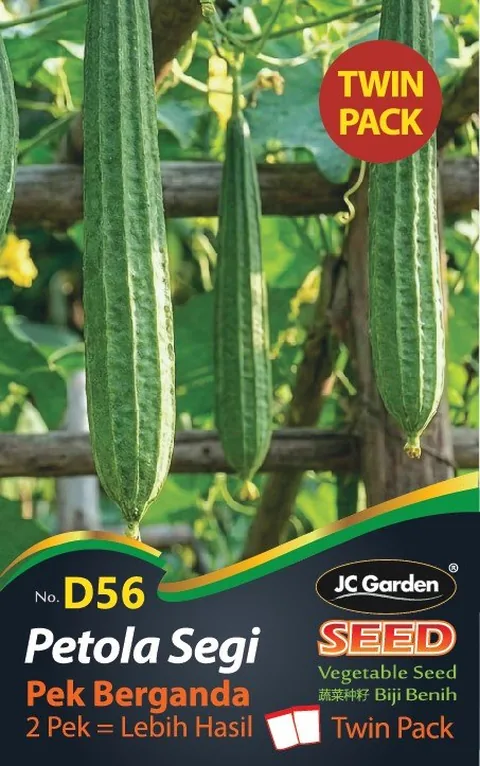
Angled Loofah Seeds
Vigorous, easy climbing gourd for lowland gardens — pick the fruit young for cooking.
Trellising and pruning
Set up the trellis before the vine runs — at least 2 m tall and strong, because a fruiting loofah is heavy, especially after rain. Tie the main stem loosely until the tendrils take hold.
- Remove side shoots on the lowest 50–60 cm so the plant builds a strong main stem and the base stays airy.
- Above that, let side shoots grow; they bear many female flowers.
- On a flat para, let the vine spread across the top and remove old yellow leaves underneath.
- If the vine outgrows your space, pinch the growing tips. This also pushes it into producing more side shoots and flowers.
Watering in hot and rainy weather
Loofah drinks a lot. In hot, dry weather water deeply at the base every morning, and check large pots again in the late afternoon. Mulch with straw, dried leaves or rice husk to keep moisture steady.
During rainy spells, do not water if the soil is still wet, and keep drainage clear. Loofah copes with rain better than cucumber, but waterlogged roots still rot. Water in the morning so the leaves dry before night.
Feeding
- Early growth: a balanced fertilizer every 2 weeks, or diluted liquid fertilizer weekly.
- Flowering and fruiting: switch to a formula with more potassium (K) than nitrogen (N), little and often. Too much nitrogen gives a huge vine with few fruit.
- Top up with compost every month — a vine this size uses up the soil quickly.
Flowering and hand pollination
Loofah has bright yellow male and female flowers on the same plant. Male flowers grow in clusters on a long stalk and appear first. A female flower sits alone, with a small baby loofah behind its petals.
Bees, carpenter bees and other insects usually pollinate loofah well. If baby fruit shrivel and drop, hand-pollinate: take a freshly opened male flower, peel back its petals and rub the pollen onto the centre of an open female flower. Do it while the flowers are fresh — smooth loofah flowers usually open in the morning, while angled loofah flowers often open from late afternoon, so look at your plant to see when its flowers open.
Bagging against fruit flies
Melon fruit flies sting young loofah and lay eggs under the skin, leaving twisted, rotting fruit. Once a fruit has clearly set, slip a paper bag, newspaper tube or fine mesh bag over it, close it around the stalk, and leave a small opening at the bottom so rain drains out. Collect fallen or stung fruit and hang fruit fly traps a little away from the vine.
Common pests and diseases in Malaysia
- Red pumpkin beetle: orange beetles chewing round holes in leaves and flowers. Hand-pick in the cool morning and net young seedlings.
- Aphids, whiteflies and thrips: sap-suckers under leaves that can spread mosaic viruses. Wash off, use yellow sticky traps and spray neem oil in the evening every 5–7 days.
- Caterpillars: leaf-rolling caterpillars hide in folded leaves. Pinch them out by hand.
- Downy and powdery mildew: yellow patches or white powder on leaves, worse in crowded vines. Remove affected leaves, improve airflow and water at the base.
More organic methods:
Harvesting
Pick loofah young, while it is still firm, slightly flexible and your fingernail presses into the skin easily. As a rough guide, angled loofah is ready at about 20–30 cm and smooth loofah at about 15–25 cm, though size varies by variety. Often this is only about a week after the flower was pollinated, so check every day or two. Cut with shears. Peel angled loofah along the ridges before cooking.
Making a sponge: leave a few smooth loofahs on the vine until the skin turns yellow-brown and dry and the fruit feels light. Then peel off the skin, shake out the seeds (keep them for sowing), wash the fibre and dry it in the sun.
FAQ
Why is my loofah tough and stringy?
It was picked too late. Loofah turns fibrous fast; harvest earlier and check the vine more often.
Which type is better, angled or smooth?
Both are tasty when young. Angled loofah is the common market type; smooth loofah is very productive and also makes the better sponge. Grow whichever your family prefers.
Can I grow loofah on a condo balcony?
Yes, if you have strong sun and space to climb. One plant is plenty; trim it to keep it in bounds.
Related guides: