
How to Grow Bottle Gourd (Labu Air) at Home in Malaysia
How to grow bottle gourd (labu air) in Malaysia — soaking hard seeds, strong trellis, pinching for female flowers, evening pollination and fruit fly bags.
- Difficulty
- Medium
- Days to harvest
- 60–75 days
- Updated
- 2026-11-04
Yes — bottle gourd (labu air) grows very well in lowland Malaysia's heat and humidity. Expect the first young fruit about 60–75 days after sowing, and a healthy vine keeps producing for weeks. It is a big plant that needs a strong trellis or overhead para. The one key tip: bottle gourd's white flowers open in the evening, so if fruit are not setting, hand-pollinate at dusk rather than in the morning — and pinch the main vine so it makes side shoots, where most female flowers form.
Quick facts
| Item | Bottle gourd (labu air) |
|---|---|
| Sun | Full sun, 6–8 hours |
| Sowing depth | 2–3 cm; soak seeds 24 hours first |
| Germination | 5–10 days, sometimes up to 2 weeks |
| Spacing | 90–120 cm between plants |
| Days to harvest | About 60–75 days from sowing to first young fruit |
| Container | At least 50 L per plant, 45 cm deep |
| Support | Yes — a strong overhead para or sturdy trellis about 2 m high |
Choosing a spot and container
Bottle gourd is one of the largest gourd vines. A single plant can cover a car-porch frame or a 2 × 2 m overhead para in a terrace-house yard. The para is the classic way to grow it in Malaysia: the vine spreads across the top and the fruit hang down cleanly, which also keeps long types straight.
If you only have a balcony, it can work in a 50 L or larger container with a strong frame, but it is a squeeze. A container that size full of wet soil is heavy, so check the load:
Soil and potting mix
Bottle gourd is a heavy feeder. Use rich, loose, well-drained soil:
- 2 parts garden soil or potting mix
- 1 part compost or well-rotted manure
- 1 part burnt rice husk (sekam bakar) or cocopeat
In the ground, dig a planting pit about 45 cm wide and deep, and fill it with soil mixed with a generous amount of compost.
How to sow bottle gourd step by step
- Soak the seeds for about 24 hours. Bottle gourd seeds have a very hard coat. For seeds that stay hard after soaking, gently nick the edge of the coat with a nail clipper — avoid the pointed end, where the root emerges.
- Sow 2 seeds per spot 2–3 cm deep, pointed end down or the seed on its edge.
- Keep the mix moist but not soggy in a warm spot. Most seeds sprout in 5–10 days; a few can take up to 2 weeks.
- Thin to the strongest seedling by snipping the other at soil level.
- If started in cups, transplant at 2–3 true leaves. Lift the whole root ball without disturbing the roots, plant in the late afternoon, water well and shade lightly for a day.
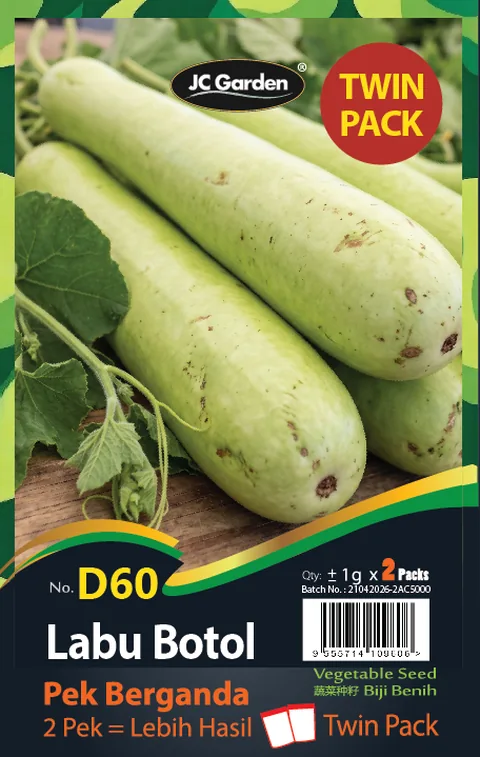
Bottle Gourd Seeds
Big, productive gourd vine for an overhead para or strong trellis — young fruit in about 60–75 days.
Trellising and pinching
Build the support before planting. A fruiting bottle gourd is very heavy, so use thick bamboo, metal poles or strong wire mesh, and tie the main stem loosely until tendrils take hold.
Bottle gourd forms many of its female flowers on side shoots, not the main vine. So:
- Remove side shoots on the lowest 50–60 cm of the stem.
- When the main vine reaches the top of the trellis or para (around 1.5–2 m), pinch out its tip.
- Let the side shoots that grow from there spread across the top. If they get very long, pinch their tips too, to encourage more flowering branches.
- Remove old yellow leaves underneath to keep air moving.
Watering in hot and rainy weather
The vine has huge leaves and drinks a lot. In hot, dry weather water deeply at the base every morning, and check containers again in the late afternoon. Mulch the root zone with straw, dried leaves or rice husk.
In rainy spells, hold off watering while the soil is still wet and make sure water drains away from the base of the stem. Water in the morning so leaves dry before nightfall.
Feeding
- Early growth: a balanced fertilizer every 2 weeks, or diluted liquid fertilizer weekly.
- From first flowers: switch to a formula with more potassium (K) than nitrogen (N), little and often.
- Add a layer of compost around the plant every month. Heavy nitrogen feeding makes leaves, not fruit.
Flowering and hand pollination
Bottle gourd has large white male and female flowers on the same plant. Unlike most gourds, the flowers open in the late afternoon or evening and stay open into the night, so they are visited by moths and other night insects. A female flower has a small, fuzzy baby gourd behind its petals.
If baby gourds turn yellow and drop, hand-pollinate around dusk, when the flowers have just opened:
- Pick a freshly opened male flower and remove its petals.
- Brush its pollen gently onto the centre of an open female flower.
- Use a torch if needed. One male flower can pollinate two or three females.
Bagging against fruit flies
Melon fruit flies attack young bottle gourds too, leaving rotten or twisted fruit. As soon as a fruit has set, cover it with a paper bag, newspaper wrap or fine mesh bag, closed around the stalk with a small opening at the bottom for drainage. Collect fallen fruit and hang fruit fly traps a little away from the vine. For heavy fruit, a net or cloth sling tied to the para takes weight off the stalk.
Common pests and diseases in Malaysia
- Red pumpkin beetle: orange beetles that chew holes in leaves, especially on young plants. Hand-pick in the cool morning and protect seedlings with netting.
- Aphids, whiteflies and thrips: sap-suckers under leaves; can spread viruses. Wash off, use yellow sticky traps and spray neem oil in the evening every 5–7 days.
- Downy and powdery mildew: yellow angular patches or white powder on leaves. Remove affected leaves, keep the canopy open and water at the base.
- Stem rot at soil level: a soft, dark stem base in waterlogged soil. Improve drainage and keep mulch a few centimetres away from the stem.
More organic methods:
Harvesting
Pick bottle gourd young, while the skin is still covered in fine soft hairs and your fingernail pierces it easily. Size depends on the variety — round types and long types differ a lot — so go by tenderness, usually about one to two weeks after pollination. Cut the stalk with shears. An over-mature gourd develops a hard skin and tough seeds; it is no longer good to eat, but if left to dry fully on the vine it becomes a hard shell (calabash) you can use as a container or craft gourd.
FAQ
My vine is huge but has only male flowers. Why?
Female flowers mostly appear on side shoots. Pinch the main vine tip, let side shoots grow, and cut back on nitrogen fertilizer.
Do I really need to pollinate at night?
Only if fruit are not setting. Check the vine at dusk — that is when the flowers open and when hand pollination works best.
Can I eat the leaves and shoots?
Young shoot tips and leaves of bottle gourd are cooked as a vegetable in some Asian cuisines. Only pick a few, so the vine keeps its strength for fruit.
Related guides: