
How to Grow Sweet Corn (Jagung Manis) at Home in Malaysia
How to grow sweet corn in Malaysia: block planting for full cobs, polybag spacing, feeding, hand pollination, fall armyworm control and harvest timing.
- Difficulty
- Medium
- Days to harvest
- 65–85 days
- Updated
- 2026-11-04
Yes — sweet corn (jagung manis) grows well in lowland Malaysia's heat and sun, and most varieties are ready about 65–85 days after sowing. It is a big, hungry plant, so it suits terrace-house yards and large polybags better than small balconies. The one key tip: plant in a block, not a single row. Corn is wind-pollinated — pollen falls from the tassel at the top onto the silks of neighbouring plants — so a square block of at least 3 × 3 plants gives full, well-filled cobs, while a lone row often gives cobs with gaps.
Quick facts
| Item | Sweet corn |
|---|---|
| Sun | Full sun, 8 hours or more |
| Sowing depth | 3–4 cm |
| Germination | 4–7 days |
| Spacing | 25–30 cm between plants, rows 60–75 cm apart, in a block |
| Days to harvest | About 65–85 days, depending on variety |
| Container | One plant per polybag of at least 20 L (about 35 × 35 cm) |
| Support | Hill up soil at the base; stake in windy spots |
Choosing a spot and container
Corn needs the sunniest, most open spot you have. In a yard, plant a block of short rows — for example 4 rows of 4 plants — rather than one long line along the fence. On a large terrace or roof, use polybags of 20 L or more and stand them close together in a square, so the tassels and silks sit near each other.
A small condo balcony is usually not ideal: plants grow 1.5–2 m tall, need lots of sun and need enough companions for pollination. If you really want to try, grow at least 6–9 plants grouped together and plan to hand-pollinate.
Keep sweet corn away from field corn or popcorn flowering at the same time; cross-pollination can make sweet corn kernels starchy and less sweet.
Soil and potting mix
Corn is a heavy feeder. Use a rich, well-drained mix:
- 2 parts garden soil or potting mix
- 1 part compost or well-rotted manure
- 1 part burnt rice husk (sekam bakar) or cocopeat
In the ground, dig in plenty of compost and raise the beds slightly so roots do not sit in water after storms. Mix a dose of balanced granular fertilizer into the soil at planting, following the label rate.
How to sow sweet corn step by step
- Sow directly. Corn seedlings dislike root disturbance. Sow straight into the bed or polybag. If birds, squirrels or heavy rain are a problem, start seeds in deep cups and transplant within 2 weeks.
- Make holes 3–4 cm deep. Space them 25–30 cm apart in a block.
- Drop 2 seeds per hole. Cover and firm the soil.
- Water well. Keep moist but not soggy; seeds rot in waterlogged soil. Seedlings appear in 4–7 days.
- Keep one. When seedlings are 10 cm tall, snip the weaker one at soil level.
- Stagger sowings. Sow a new block every 2–3 weeks for a longer harvest; each block ripens all at once.
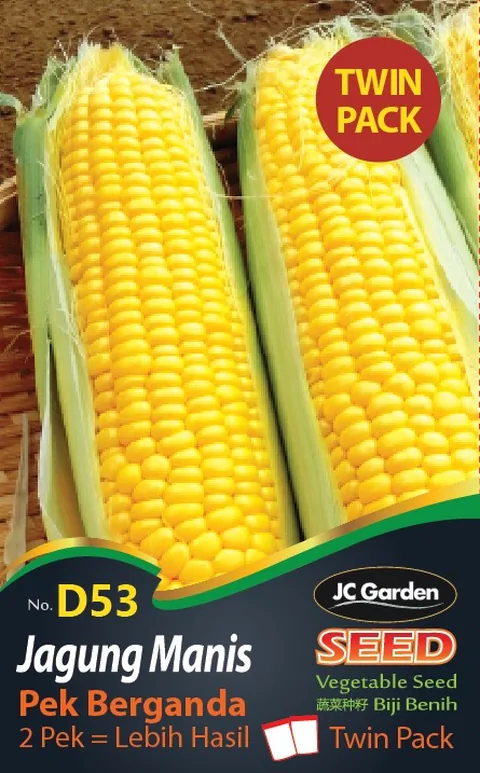
Sweet Corn Seeds
Heat-loving sweet corn for yards and big polybags — plant in a block for full, well-filled cobs.
Hilling up and support
When plants are knee-high, pull soil or add compost around the base of each stem to a height of 5–10 cm. This covers the brace roots that grow from the lower stem and helps plants stand up to wind and afternoon storms. In exposed spots, tie each plant loosely to a bamboo stake. Side shoots at the base can be left alone; removing them is not necessary.
Watering in hot and rainy weather
- Corn needs the most water from tasselling to cob filling. Never let it dry out then — dry soil at this stage gives small cobs with missing kernels.
- Hot spells: water polybags deeply every morning, and check again in the late afternoon.
- Rainy season: make sure beds and polybags drain freely. Long wet spells encourage stem rot and leaf disease, and strong winds can flatten tall plants — this is why the calendar avoids the wettest months.
- A mulch of dried grass, straw or rice husk keeps the roots cool and moist.
Feeding
- At planting: compost plus a balanced granular fertilizer at the label rate.
- About 3–4 weeks after sowing (knee-high): side-dress with a nitrogen-rich or balanced fertilizer, scattered around the plant, not touching the stem, then water in.
- At tasselling: a final feed of balanced fertilizer helps fill the cobs.
Pale yellow lower leaves while the plant is still young usually means hunger for nitrogen. To convert fertilizer label numbers or compare products, use:
Pollination
The tassel at the top sheds pollen, and each strand of silk on a young cob must catch pollen to make one kernel. In a good block, wind does the job. To help small plantings:
- On a calm morning, when the tassels are shedding yellow pollen, bend a tassel or tap it over a paper bag.
- Sprinkle the collected pollen onto the fresh silks of other plants.
- Repeat every morning for 3–4 days while the silks are fresh.
Common pests and diseases in Malaysia
- Fall armyworm (ulat ratus fall). The most serious corn pest in Malaysia. Caterpillars hide deep in the leaf whorl, leaving ragged holes and sawdust-like droppings. Check the whorls every few days from the seedling stage, crush caterpillars and egg masses by hand, and spray neem oil into the whorl in the evening.
- Corn earworm and stem borers. Caterpillars tunnel into the cob tip or stem. Remove damaged cobs, cut the tip off affected ears when harvesting and clear crop debris after harvest.
- Aphids. Colonies on tassels and upper leaves. Hose them off or spray mild soapy water.
- Downy mildew and leaf blight. Pale streaks or long brown lesions on leaves in wet weather. Space plants well, avoid overhead evening watering and remove badly affected plants.
- Birds, squirrels and rats. They attack ripening cobs. Cover each cob with a paper or mesh bag after the silks turn brown.
More organic options:
Harvesting
Sweet corn is usually ready about 18–24 days after the silks appear. Signs that a cob is ready:
- The silks have turned brown and dry.
- The cob feels full and firm, with a rounded tip.
- Peel back a little husk and press a kernel with your thumbnail: milky juice means ready. Clear, watery juice means wait a few days; thick paste means it is past its best.
Twist the cob down and off the stalk. Sweetness drops quickly after picking, so cook or refrigerate it as soon as possible. Each plant usually gives one or two good cobs.
FAQ
Why are my cobs missing kernels? Poor pollination — usually a single row, too few plants, or dry soil at silking. Plant in a block and hand-pollinate.
Can I grow sweet corn in polybags? Yes, one plant per 20 L polybag, grouped closely in a square of at least 9.
How many cobs does one plant give? Usually one main cob, sometimes a smaller second one. Plan the number of plants accordingly.
Can I save seed from my sweet corn? Seed from hybrid varieties will not grow true to type, so buying fresh seed for each planting is more reliable.