
How to Grow Plantain Herb (Plantago) from Seed in Malaysia
How to grow plantain herb (Plantago, daun senduk, 车前草) in Malaysia — not the banana. Surface sowing, pots, watering, pests and picking leaves.
- Difficulty
- Easy
- Days to harvest
- 60–75 days
- Updated
- 2026-11-05
Yes — plantain herb grows easily in lowland Malaysia. It is a tough, low rosette plant that handles heat, heavy rain, partial shade and even poor, compacted soil, so it is one of the most forgiving herbs for beginners. From seed you can start picking the outer leaves about 60–75 days after sowing, and the plant keeps producing for months. The one key tip: surface sow and do not cover the seed, because it needs light to germinate — and later, cut off the flower spikes before they ripen so the plant keeps making leaves instead of seeding itself everywhere.
Not the banana. This is Plantago, a small leafy herb known in Malay as daun senduk or ekor anjing and in Chinese as 车前草. It has nothing to do with the cooking banana called "plantain" (pisang tanduk, pisang abu and similar). The name is the same in English only by coincidence.
Quick facts
| Item | Plantain herb |
|---|---|
| Sun | Full sun to partial shade |
| Sowing depth | Surface sow, press in, do not cover (needs light) |
| Germination | 7–14 days |
| Germination temperature | About 20–30°C |
| Thinning | First to about 5 cm apart |
| Spacing | 15–20 cm between plants |
| First leaf picking | About 60–75 days after sowing, then picking for months |
| Container | At least 15–20 cm deep; troughs and polybags work well |
| Support | None needed |
Recognising the plant
Plantain herb grows as a flat rosette of broad, oval leaves with strong parallel ribs running from the base to the tip. From the centre it sends up thin, upright stalks topped with long, narrow green spikes of tiny flowers, which later turn brown with seed. It is easy to tell apart from weeds once you know the ribbed leaves.
Choosing a spot and container
Almost any spot works. Full sun gives compact plants with thicker leaves; partial shade gives larger, softer leaves, which many people prefer for cooking. On a condo balcony, a spot with 3–4 hours of sun is enough.
Because the plant is low and leafy, width matters more than depth. A long planter trough, a styrofoam box with drainage holes or a few polybags at least 15–20 cm deep are ideal. One trough of 60 cm can hold three or four plants.
Soil and potting mix
Plantain herb is not fussy. Ordinary garden soil or potting mix with a little compost is fine. It tolerates poor, compacted soil better than most herbs, but leaves are more tender in loose, moist soil. Make sure containers drain.
How to sow plantain herb step by step
- Prepare the container. Fill a tray, trough or pot with moist mix and level the surface. Water before sowing.
- Scatter the seed. Sprinkle the small seeds thinly over the surface. For pots where plants will grow, sow a pinch of 3–4 seeds every 15–20 cm.
- Press, don't cover. Press the seed firmly onto the mix with your palm. Do not cover — it needs light.
- Keep moist. Mist or water gently with a fine rose so the surface never dries until seedlings appear, usually in 7–14 days. A clear cover helps in hot, dry weather; keep it out of direct sun.
- Thin. When seedlings have 2–3 leaves, thin them to about 5 cm apart.
- Space out. At 4–5 leaves, thin again or transplant to 15–20 cm apart.
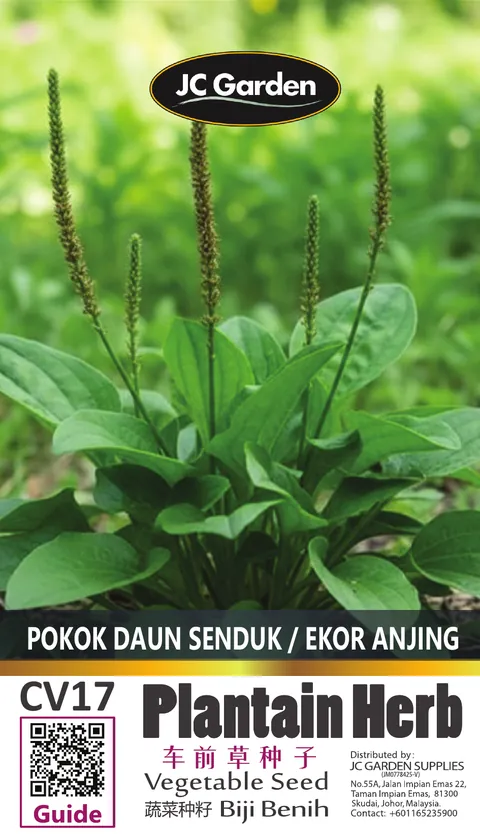
Plantain Herb Seeds
Low rosette herb with broad, ribbed leaves, traditionally used for tea and as a cooked green.
To work out how many seeds to scatter for a tray or planter, try the calculator:
Transplanting
Seedlings from trays transplant easily. Lift them with plenty of soil around the roots, plant at the same depth (do not bury the crown, the centre of the rosette), and water well. Keep in light shade for two or three days while they settle.
Watering in hot and rainy weather
- Dry spells: mulch the surface with dry leaves or rice husk and water in the morning. Leaves become tough and bitter if the plant goes short of water.
- Rainy season: plantain herb copes well with rain. Just check that containers drain and the crown does not sit in mud.
Feeding
Very little is needed. From about week 4, give a light feed once a month, or top-dress with compost. More feeding mainly makes bigger, softer leaves — fine if you pick often.
Controlling flowering and self-seeding
Plantain herb flowers readily. Each spike produces a lot of tiny seed, and the plant will happily seed itself into lawns, paving cracks and neighbouring pots. Cut off the flower stalks at the base while they are still green. This keeps the plant leafy and stops it turning into a weed in your garden.
If you want to save seed, let one or two spikes turn brown, cut them into a paper bag and let them dry for a week before shaking out the seed.
Common problems in Malaysia
- Snails and slugs. The main pest, especially after rain. They chew holes in the leaves at night. Pick them off with a torch after dark and keep the area around pots clear.
- Aphids. Small clusters on young leaves or flower stalks. Spray with water or a mild soap or neem solution.
- Leaf spots and mildew. Brown spots or white dusty patches in humid, crowded plantings. Remove affected leaves and give plants more space.
Harvesting
From about day 60–75, pick the outer leaves by cutting or snapping them at the base, always leaving the centre to keep growing. Young, mid-sized leaves are the most tender. Pick a few from each plant every week or two rather than stripping one plant.
The leaves are traditionally used for tea and young ones are cooked as a green, for example in soups or stir-fries.
This guide is about growing the plant; it is not medical advice.
FAQ
Will it grow in a shady spot? Yes, with 3–4 hours of light it grows well; in deep shade it becomes thin and slow.
Is it a perennial? It can live for a long time in our climate if you keep removing flower spikes. Older plants slow down, so sow a fresh pot now and then.
Why are new plants appearing all over my garden? The flower spikes were left to ripen. Cut them off earlier and pull up stray seedlings while they are small.