
How to Grow Petunia from Seed in Malaysia (An Honest Guide)
How to grow petunia in lowland Malaysia: sowing tiny seed on the surface, best months, rain shelter, hanging baskets, feeding, pests and what to expect.
- Difficulty
- Harder
- Days to harvest
- 70–90 days
- Updated
- 2026-11-04
Petunias can flower in lowland Malaysia, but honestly, they are not easy here. They prefer warm days and cooler nights, and they suffer in our constant heat and heavy rain: flowers bruise and rot, plants get leggy, and roots rot in wet pots. Petunias grow much better in the highlands such as Cameron Highlands. In the lowlands, expect first flowers about 10–12 weeks after sowing and a shorter, more delicate season than in cooler places. The one key tip: grow them under a roof edge or rain shelter, in a hanging basket or pot that drains fast, with morning sun and some shade from the harsh afternoon sun.
Quick facts
| Item | Petunia |
|---|---|
| Sun | Morning sun plus bright light; 4–6 hours direct sun, with light shade in the hottest afternoon hours |
| Sowing depth | Surface — do not cover; the seed needs light to germinate |
| Germination | 7–14 days |
| Spacing | 20–30 cm; 3 plants in a 25–30 cm hanging basket |
| Days to first flowers | About 70–90 |
| Container | Hanging basket, window box or 15–20 cm pot, with very good drainage |
| Support | None; trailing types hang over the edge |
Before you start: choosing types and timing
- Choose multiflora and trailing or spreading types. These have smaller flowers that shrug off rain better than the large, ruffled grandiflora types. Look for varieties described as heat-tolerant or weather-tolerant.
- Use pelleted seed if you can. Petunia seed is dust-fine; pellets coat each seed so you can see and place it.
- Time it for drier weather. On the west coast, sow around January–February or May–July so plants bloom in the generally drier months. Avoid sowing so that flowering lands in the wettest weeks of the monsoon, especially on the east coast.
- Consider calibrachoa (million bells). A close relative with small petunia-like flowers, usually sold as cutting-grown plants, and it often copes with heat a little better.
Choosing a spot and container
The best place in the lowlands is somewhere bright but sheltered: under the eaves of a porch, a balcony with a roof above, or hanging from a pergola with a clear roof. Morning sun with light shade after about 1 pm is ideal. Direct, constant rain is the biggest problem — the soft petals turn to mush and fungal disease follows.
Hanging baskets suit petunias well because they drain quickly and the trailing stems can spill over. Make sure any basket or pot has plenty of drainage holes. Avoid deep pots of heavy soil.
Soil and potting mix
Petunias need a light, airy mix that never stays soggy:
- 2 parts good-quality potting mix or cocopeat-based mix
- 1 part perlite or burnt rice husk (sekam bakar)
- A small handful of compost
Do not use garden soil on its own. It compacts in pots and holds too much water.
How to sow petunia step by step
Petunia seed needs light to germinate, so it must not be buried. If you are used to sowing seeds in the dark, this is the opposite.
- Fill a seedling tray with fine, moist seed-starting mix, firmed and levelled.
- Water the mix first, from below if possible, so you do not have to water hard on top of the seeds.
- Sow on the surface. Tip the seed or pellets onto a folded piece of paper and tap them gently across the tray, one or two per cell. Do not cover them with soil.
- Press lightly with a flat hand so the seed touches the moist mix.
- Cover the tray with a clear lid or plastic bag to keep humidity up, and place it in bright, indirect light — not direct sun, which cooks the tray. A cooler indoor spot near a bright window helps in the hottest months.
- Mist, do not pour. Keep the surface moist with a sprayer. Seedlings usually appear in 7–14 days.
- Remove the lid once most seeds have sprouted, and move the tray into gentle morning sun.
- Prick out seedlings into small pots when they have 2–3 true leaves. They are tiny and slow at first; this is normal.
For more about light-needing and dark-needing seeds:
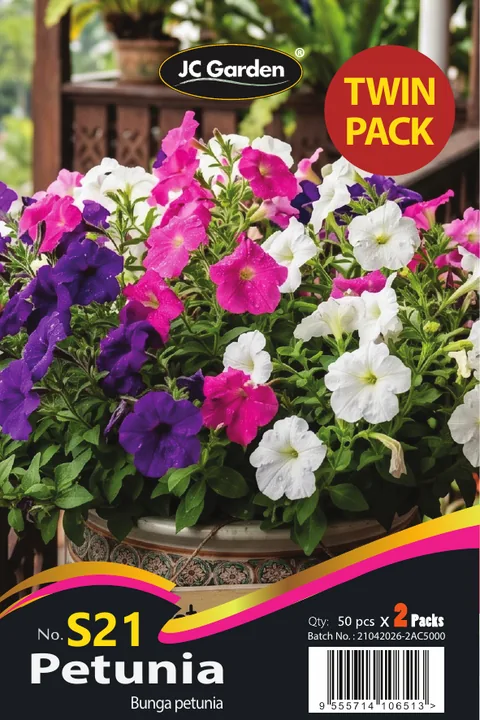
Petunia Seeds
For patient growers: petunia for sheltered hanging baskets — harder in lowland heat and heavy rain.
Transplanting and pinching
When seedlings are about 5–8 cm tall with several leaves, plant them in their final basket or pot in the late afternoon. Keep them in light shade for a few days.
Pinch out the growing tip once plants have about 6 leaves to make them branch. If plants get long and straggly later — common in the heat — cut the stems back by up to half. With feeding, they regrow and flower again.
Watering in hot and rainy weather
- Water when the top 1–2 cm of mix is dry. Hanging baskets dry out fast in hot weather and may need water every morning.
- Water the soil, not the flowers.
- In rainy weeks, move baskets under shelter, skip watering if the mix is damp, and tip out water from saucers. Waterlogged petunias rot quickly.
Feeding
Petunias are hungry plants, especially in pots where frequent watering washes nutrients out.
- Start feeding about 2 weeks after transplanting.
- Use a balanced liquid fertilizer at half the label rate every week, rather than full strength less often.
- If new leaves turn yellow between green veins, the plant may be short of iron or the mix may be too alkaline; a feed with trace elements usually helps.
Common pests and diseases in Malaysia
- Aphids and whitefly. Clusters under leaves and on new growth; sticky leaves. Spray with water, then neem oil or a mild soap solution every 5–7 days in the evening.
- Thrips. Streaked, damaged petals and distorted buds. Neem oil sprays and blue sticky traps help.
- Caterpillars (budworms). Holes in buds and flowers. Check at dusk and hand-pick.
- Grey mould (botrytis). Grey fuzz on wet, fading flowers and leaves. Remove dead flowers promptly and keep plants out of the rain.
- Root and stem rot. Wilting while the mix is wet. Improve drainage and water less; badly affected plants rarely recover.
- Damping-off in seedlings. Seedlings collapse at the base. Use clean mix, avoid overwatering and give airflow once seedlings are up.
More organic fixes:
Deadheading
Pinch off faded flowers, including the small green swelling behind each one where seed forms. This keeps the plant blooming and removes petals that would otherwise rot. Do it every few days.
FAQ
Why did my petunia flowers turn to mush after rain? Petunia petals are very soft and bruise in heavy rain. Move plants under shelter and choose small-flowered multiflora or trailing types.
My petunia seeds never came up. What went wrong? The most common reasons are covering the seed with soil, letting the surface dry out, or a tray sitting in hot direct sun. Sow on the surface, keep it moist under a cover and give bright, indirect light.
Can petunias flower all year in the lowlands? Usually not reliably. Most home growers treat them as a seasonal display and sow a fresh batch for the drier months.
What is easier for a hot, sunny balcony? Periwinkle and marigold handle heat far better: