
How to Grow Mugwort (Artemisia) from Seed in Malaysia
How to grow mugwort (Artemisia) in Malaysia: sowing dust-fine seed, why it spreads, container tips, rainy-season pruning, pests and picking young tips.
- Difficulty
- Medium
- Days to harvest
- 60–90 days
- Updated
- 2026-11-05
Yes — mugwort (Artemisia, 艾草) grows well in lowland Malaysia. It copes with heat and rain far better than most temperate herbs, and once established it is close to unkillable. From seed, the first young tips are ready to pick about 60–90 days after sowing, and a healthy plant keeps producing for years. The tricky part is the beginning: the seed is dust-fine, so the seedling stage needs gentle care. The one key tip for later: mugwort spreads vigorously through underground runners, so grow it in a large pot rather than loose in a garden bed unless you want it everywhere.
Quick facts
| Item | Mugwort |
|---|---|
| Sun | Full sun to partial shade |
| Sowing depth | Surface sow, press in, cover very lightly or not at all |
| Germination | 7–14 days |
| Germination temperature | About 18–28°C |
| Spacing | 30–40 cm between plants |
| First leaf picking | About 60–90 days after sowing, then picking for years |
| Container | 30–40 cm wide pot or large polybag per plant |
| Support | None needed |
Choosing a spot and container
Mugwort is happy in full sun, but in lowland heat a spot with morning sun and some afternoon shade gives softer, more tender leaves — which is what you want for cooking. It will also grow in partial shade, though it becomes taller and leggier.
Why a container matters. Mugwort sends out underground runners (rhizomes) that pop up new shoots some distance from the parent plant. In a garden bed it can take over a corner within a season and is hard to dig out completely, because small root pieces regrow. For most homes, the best plan is:
- One plant per wide pot, 30–40 cm across, or a large polybag.
- Stand the pot on paving, a tile or a stand, not on bare soil, so runners cannot escape through the drainage holes.
- If you do plant in the ground, sink a large bottomless container or root barrier around it, at least 30 cm deep.
- Cut off flower stems before seed forms, as mugwort can also self-seed.
To work out how much potting mix a big pot needs, use the calculator:
Soil and potting mix
Mugwort is not fussy. Ordinary, well-drained garden soil or potting mix with a little compost is enough. Rich soil is not necessary — too much fertility gives tall, floppy growth. What it does need is drainage, especially in the rainy season, so add a handful of sand or burnt rice husk (sekam bakar) if your mix is heavy. For sowing, use a fine seedling mix.
How to sow mugwort step by step
- Mix with sand. The seed is so fine it is hard to spread evenly. Mix it with a spoonful of dry fine sand in a folded paper.
- Prepare a tray. Fill a seedling tray or shallow pot with fine, moist seedling mix and water it before sowing.
- Scatter thinly. Sprinkle the seed-and-sand mix over the surface. Press it in gently with your palm. Cover very lightly, or not at all.
- Keep humid. Cover the tray with clear plastic or a lid and place it in bright shade, not direct sun.
- Mist daily. Use a spray bottle so the seed is not washed away. Seedlings usually appear in 7–14 days.
- Ventilate and thin. Once seedlings are up, remove the cover gradually and snip out crowded ones with scissors, leaving the strongest.
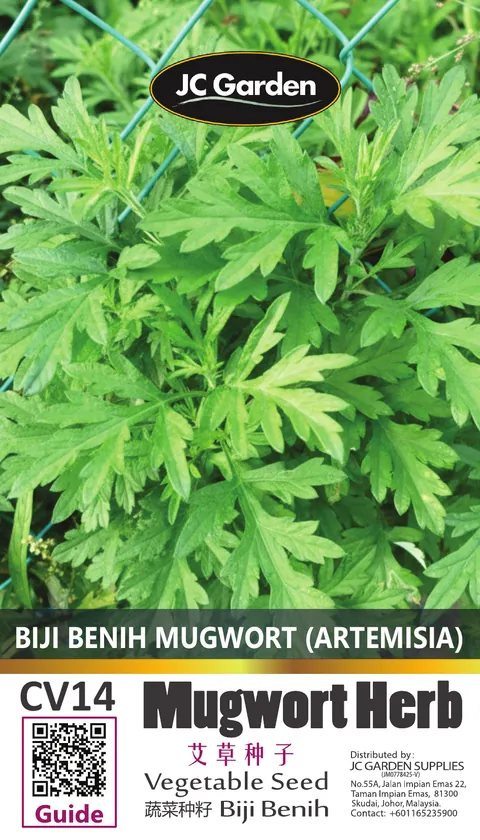
Mugwort (Artemisia) Seeds
Aromatic silver-green herb traditionally used in kuih, glutinous rice cakes and herbal tea.
Transplanting
When seedlings have 5–6 leaves, move them into small pots, then into their final large pot a few weeks later, or plant out 30–40 cm apart. Water well after moving and keep them in light shade for a few days. Mugwort seedlings are slow for the first month, then speed up quickly.
Pruning and keeping it tidy
Regular cutting is the key to good mugwort. Pick the young tips often and the plant branches and stays bushy with tender leaves. Left alone, it becomes tall, woody and sparse at the base.
After the rainy season, plants often look leggy and tired. Cut all the stems back to about 15–20 cm; fresh shoots soon appear from the base. Every year or two, lift the plant, trim the root mass and replant a healthy piece with fresh mix.
Watering in hot and rainy weather
- Dry spells: water when the topsoil is dry, preferably in the morning. Big pots hold water well, so check with a finger first.
- Rainy season: mugwort tolerates rain, but not waterlogged roots. Make sure pots drain freely and raise them off wet ground.
Feeding
Mugwort needs very little feeding. From about week 4, give a light feed once a month, or simply top-dress with compost every couple of months. Overfeeding gives soft growth that flops over and attracts aphids.
Common problems in Malaysia
- Aphids. The most common pest — clusters on tender tips. Cut off badly infested tips (you were going to pick them anyway), spray the rest with water or a mild soap or neem solution.
- Spider mites. Fine speckling and webbing in hot, dry weather, especially under a roof overhang. Spray the undersides of leaves with water regularly.
- Powdery mildew. White dusty patches in humid, crowded conditions. Thin the stems, improve airflow and remove affected leaves.
- Root rot. Wilting despite wet soil means poor drainage. Repot into a grittier mix.
Harvesting
Start picking from about day 60–90, once the plant is bushy. Snip the top 10–15 cm of young shoots; these are the most tender and aromatic. Pick in the morning and use fresh, or blanch and freeze for later.
Mugwort leaves are traditionally used in cooking, for example in green glutinous rice cakes such as 艾草粿, in kuih, fried with egg, and as a herbal tea.
This guide is about growing the plant; it is not medical advice.
FAQ
Can I grow mugwort from a cutting or a piece of root? Yes, and it is much faster than seed. A rooted piece of runner from a friend's plant will establish in a few weeks.
Why is my mugwort spreading into other pots? Runners can escape through drainage holes into the soil below. Stand the pot on a hard surface and pull up stray shoots as soon as you see them.
Can I grow it with other herbs in one planter? Not recommended — it will crowd them out. Give it its own pot, just as you would for mint.