
How to Grow Malabar Spinach (Remayung) from Seed in Malaysia
How to grow Malabar spinach (remayung) in Malaysia: soaking seeds, a simple trellis, watering, feeding, leaf spot and picking tips for months.
- Difficulty
- Easy
- Days to harvest
- 45–60 days
- Updated
- 2026-11-05
Yes, Malabar spinach (remayung, bayam Malabar) is one of the best leafy greens for lowland Malaysia. It loves heat, humidity and rain, just when most "spinach" sulks. From seed you can start picking tips in about 45–60 days and keep picking for months. Two things matter most: be patient, because the hard seeds can take up to three weeks to sprout, and give the vine something to climb from day one.
Quick facts
| Item | Malabar spinach |
|---|---|
| Sun | Full sun to light shade; 4–6 hours of direct sun is plenty |
| Sowing | Soak overnight, sow 1 cm deep, 2–3 seeds per spot |
| Germination | Usually 10–21 days |
| Spacing | 1–2 plants per spot, spots about 30 cm apart |
| Days to harvest | About 45–60 days to first picking, then for months |
| Container | At least 30 cm wide and 25–30 cm deep per plant |
| Support | Needed: trellis, fence or netting about 1.5–2 m tall |
| Temperature | Germinates best at 25–32°C; grows at 22–35°C |
Green or red stems?
There are two common forms. The green-stemmed type (Basella alba) has large glossy green leaves. The red-stemmed type (Basella rubra) has purple-red stems and leaf veins and is a little slower but very ornamental. Both are grown the same way. The thick leaves turn slightly slippery when cooked, a little like okra, and are good in soups or fried with garlic.
Choosing a spot and container
Malabar spinach is a vine that can easily reach 2 m or more, so think vertical. A fence in a terrace-house yard, a balcony railing, or a wall with netting all work. It grows well in full sun, and unlike many greens it also copes with a balcony that gets only morning sun.
Use a pot at least 30 cm wide and 25–30 cm deep per plant, or a long planter box with two plants 30 cm apart. Bigger containers give bigger leaves and need less watering. On a balcony, check the weight first:
Soil and potting mix
It is a heavy feeder that likes rich, moist but well-drained soil:
- 2 parts garden soil or potting mix
- 1 part compost or well-rotted manure
- 1 part burnt rice husk (sekam bakar) or cocopeat
Mulch the surface with dry leaves or straw to keep the roots cool and moist.
How to sow Malabar spinach step by step
- Soak the seeds. The seed coat is hard. Soak seeds in water overnight. For faster sprouting, you can also rub the seeds lightly on sandpaper before soaking.
- Prepare the spot. Fill the container, water until it drains, and put the trellis or stake in now, before roots spread.
- Sow. Push 2–3 seeds per spot 1 cm deep, with spots about 30 cm apart.
- Cover and keep moist. Cover, firm gently and keep the mix evenly moist but not soggy.
- Be patient. Seedlings usually appear in 10–21 days and do not all come up together. Do not give up after one week.
- Thin. Keep the strongest 1–2 seedlings per spot once they have 3–4 true leaves.
You can also start seeds in small pots or a seedling tray and transplant at 10 cm tall. Malabar spinach transplants easily.
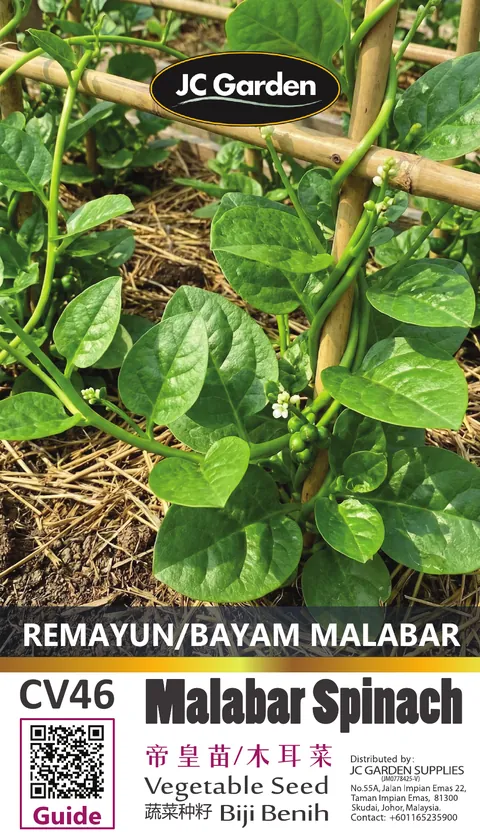
Malabar Spinach Seeds
Heat-loving climbing spinach with glossy leaves — thrives in Malaysian sun and rain, pick tips for months.
Building a simple trellis
The vine twines on its own but needs something thin to grip. Easy options:
- Three or four bamboo canes tied at the top like a teepee, set into a large pot.
- Plastic garden netting or wire mesh fixed to a fence or balcony railing.
- A simple A-frame or arch of bamboo and string in the yard.
Guide young shoots onto the support at first; after that they climb by themselves. To work out the bamboo and string you need:
Watering in hot and rainy weather
- Hot, dry spells: water deeply every morning; large pots may need a second drink in the late afternoon. Drought makes the leaves small, tough and quick to flower.
- Rainy season: it loves rain, but pots must drain. Waterlogged roots rot, and constantly wet leaves encourage leaf spot.
Feeding
Because you keep taking leaves, the plant keeps needing nitrogen.
- Mix compost into the soil at planting.
- From about two weeks after sprouting, give a light liquid fertilizer.
- Once you are picking, feed every 10 days and add a thin layer of compost every month or so.
Common problems and pests in Malaysia
- Leaf spot. Small round spots with pale centres and reddish or brown edges, worse in long rainy spells. Remove spotted leaves, improve airflow by thinning tangled vines, and water at the base.
- Snails and slugs. Common after rain. Hand-pick at night.
- Aphids and mealybugs. Clusters on young shoots. Hose off, then spray diluted neem oil or mild soap in the evening.
- Caterpillars and grasshoppers. Holes in the leaves. Hand-pick.
- Root-knot nematodes. Stunted plants with swollen lumps on the roots, mostly in old garden soil. Use fresh potting mix in pots, rotate beds, and add plenty of compost.
Harvesting
Start picking when the vines are 30–40 cm long, usually about 45–60 days after sowing.
- Pinch or cut the top 10–15 cm of each shoot, with the young leaves. Each cut makes the vine branch, so regular picking gives a bushier, leafier plant.
- Pick every week or so. In good conditions one plant gives harvests for many months.
- Small white or pink flower spikes appear as the plant matures. Pinch them off if you want more leaves.
Saving seed and cuttings
Let a few flower spikes form berries and wait until they turn purple-black. Crush them, wash out the round seed and dry it in the shade. Wear gloves: the purple juice stains hands, clothes and tiles.
It also roots easily from 20 cm stem cuttings in moist soil or water, a quick way to replace an old, woody vine.
FAQ
My seeds have not come up after a week. Are they dead? Probably not. Malabar spinach often takes 10–21 days. Keep the soil moist and warm and wait.
Can I grow it without a trellis? It will sprawl on the ground, but leaves get dirty and rot after rain. Even a single bamboo stake is better than nothing.
What other heat-loving greens can I grow? Bayam and kangkung are both easy in lowland Malaysia: