
How to Grow Lotus (Teratai) from Seed in a Container in Malaysia
How to grow lotus from seed in Malaysia: nicking and soaking seeds, planting in a container pond, full sun, feeding, mosquito control and pests.
- Difficulty
- Medium
- Days to harvest
- 180–365 days
- Updated
- 2026-11-04
Yes, lotus (Nelumbo nucifera, teratai, 荷花) grows very well in lowland Malaysia: it loves heat, strong sun and still water, and it keeps growing all year in our climate. You can grow it from seed in a large basin or tub on a terrace-house porch or a sturdy balcony. The seeds sprout within about a week once prepared, but be patient with flowers: seed-grown lotus usually takes at least 6 months and often a year or more before it blooms. The one key tip: the seed coat is extremely hard, so it must be nicked or filed and then soaked, or it can sit in water for months without sprouting. Plan for mosquito control from day one, too.
Quick facts
| Item | Lotus |
|---|---|
| Sun | Full sun, 6 hours or more; flowers poorly in shade |
| Sowing | File or nick the seed coat, soak in water; plant out once roots and leaves form |
| Germination | Usually 3–7 days after nicking and soaking |
| Spacing | One plant per container |
| Days to flower | Usually 6–12 months from seed; sometimes longer |
| Container | Watertight basin or tub without drain holes; 40 cm wide for bowl types, 60 cm or more for standard types |
| Support | None; leaves and flowers stand above the water |
Lotus or water lily?
Many people in Malaysia call both plants teratai. Lotus leaves are round, have no notch and usually stand up above the water on stalks; water beads roll off them. Its flowers rise well above the leaves, and after flowering it forms the familiar flat seed pod. Water lily leaves have a notch and float flat on the water. If you want the water lily instead, see:
Choosing a spot and container
Lotus needs full sun, ideally 6 hours or more. A sunny porch, open yard or a strong balcony with direct sun all work. In shade it may grow leaves but rarely flowers.
Use a watertight container with no drainage holes: a plastic or ceramic basin, a large glazed pot, a cut-down drum or a half-barrel liner. Small "bowl lotus" varieties can live in a container about 40 cm wide; standard lotus grows far better in something 60 cm or wider. The running roots (rhizomes) need room to spread.
Water and mud are heavy. A filled 60 cm basin can weigh well over 100 kg, so check before putting one on a condo balcony:
Soil
Lotus grows in heavy mud, not potting mix. Use clay-rich garden soil or river-bank type loam, with stones and roots picked out. Avoid potting mixes with cocopeat, bark, perlite or burnt rice husk, because they float up and cloud the water. Fill the container with about 10–20 cm of soil, wet it into a thick mud, then add a thin layer of sand or small gravel on top to keep the water clearer.
How to sow lotus seeds step by step
- Check the seed. Use whole, hard, dark seeds sold for sowing. The skinned, split white lotus seeds sold for cooking will not grow.
- Nick the seed coat. Rub a small spot of the hard coat against a metal file, coarse sandpaper or a rough concrete floor until you just see the cream-coloured layer underneath. Many growers do this at the blunt end. Go only through the coat; do not dig into the seed.
- Soak in clean water. Drop the seeds into a clear glass or jar of room-temperature water in a bright spot indoors or under shelter. Seeds should swell within a day.
- Change the water every day. Cloudy water can rot the seeds.
- Watch for the shoot. Within about 3–7 days, a green shoot appears, followed by thin stems and small leaves, then white roots.
- Plant out when the seedling has 2–3 leaves and some roots, usually 2–3 weeks after soaking. Gently press the seed into the mud, or wrap it loosely with a little mud so it does not float. Do not bury the shoots or leaves.
- Add water slowly. Start with about 5 cm above the mud. Raise it to 10–20 cm as new leaves grow.
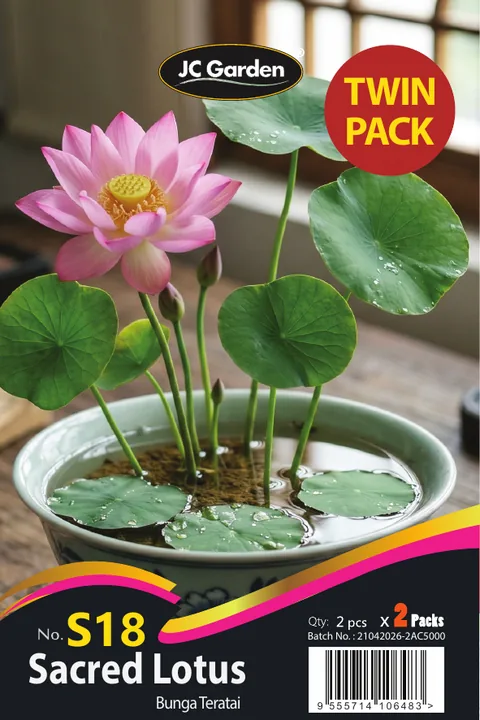
Sacred Lotus Seeds
Hard-coated lotus seeds for a sunny container pond — nick, soak and sprout, then wait patiently for flowers.
Watering and water level
Keep the container topped up. In hot, dry weather, evaporation is fast, so check every day or two and top up with tap water that has stood for a day or rainwater. Heavy rain can make the container overflow; that is fine and even flushes out mosquito larvae, but make sure the overflow does not wash away the mud or any fish.
Mosquito control
Standing water on a balcony or porch can breed Aedes and other mosquitoes, and health inspectors do check homes for breeding sites. Do not skip this:
- Add fish. A few guppies (ikan gapi) or other small, hardy fish eat mosquito larvae. Do not overfeed them; uneaten food fouls the water.
- No fish? Change or flush the water at least once a week. Mosquito larvae need about a week to become adults. Overflow the container with a hose, or scoop out larvae with a fine net.
- Keep the container from turning into a swamp of dead leaves and stagnant corners.
- Do not use mosquito sprays or oils in the water; they can harm fish and the plant.
Feeding
Wait until the plant has several leaves standing above the water. Then feed about once a month during active growth: wrap a small spoonful of NPK granules in a piece of paper or a ball of clay and push it deep into the mud, away from the growing tips. Never scatter fertilizer into the water, which feeds algae and can burn young leaves. Stop feeding if the plant looks tired or slows down.
Flowering
Lotus flowers open in the morning and partly close in the afternoon, usually for about three days, before the petals fall and the seed pod develops. Each flower is followed by more buds while the plant is strong and well fed. Lotus grown from seed may vary in colour and form from the parent plant.
Common pests and problems in Malaysia
- Aphids. On young leaves and buds. Spray them off with water. Avoid oil or soap sprays if you keep fish.
- Golden apple snail (siput gondang emas). Eats leaves; lays pink egg clusters on stems above the water. Pick off snails and scrape the eggs into the water, where they drown.
- Caterpillars. Roll or chew leaves. Hand-pick.
- Yellowing old leaves. Normal as new ones grow. Cut them below the water line with clean shears.
- Green water and algae. Too much sun on open water and too much nutrient. More leaf cover, fewer fish, no fertilizer in the water.
- Seed rot. During soaking, from cloudy water. Change water daily.
Harvesting
For a vase, cut a bud that is just starting to open, early in the morning. Mature seed pods can be dried for decoration, and some families eat the fresh green seeds from young pods. Old, dry pods also give you seeds to sow again.
FAQ
Why are my lotus seeds not sprouting? Almost always because the coat was not nicked enough, or it was nicked too deep. File just until the pale layer shows, and change the soaking water daily.
Why does my lotus have leaves but no flowers? Too little sun, a container that is too small, or the plant is simply still young. Seed-grown lotus needs time to build up its rhizomes.
Can I grow lotus on a condo balcony? Only if it gets real full sun and the balcony can bear the weight. A smaller bowl lotus variety in a 40 cm basin is the most realistic.
Do I need a pump? No. Lotus prefers still water. Fish and regular top-ups keep it healthy.