
How to Grow Jicama (Sengkuang) from Seed in Malaysia
How to grow jicama (sengkuang) in Malaysia: sowing, trellis, pinching flowers for bigger roots, watering, pests and harvest. Only the root is edible.
- Difficulty
- Medium
- Days to harvest
- 120–150 days
- Updated
- 2026-11-05
Yes — jicama, better known here as sengkuang or yam bean, grows well in lowland Malaysia and gives the crunchy, juicy root used in rojak, popiah and stir-fries. It is a long crop: plan on 4–5 months from sowing to harvest. The key tip is to pinch off the flower buds as they appear, so the plant sends its energy into the root instead of into pods. One safety point first: only the root is eaten. The seeds, pods, leaves and stems are poisonous, so never eat them and keep seeds away from children and pets.
Quick facts
| Item | Jicama (sengkuang) |
|---|---|
| Sun | Full sun, at least 6 hours of direct light |
| Sowing | Soak overnight, sow 2–3 cm deep, 2 seeds per hole |
| Germination | Usually 7–14 days |
| Temperature | Sow 25–32°C; grows best 22–35°C |
| Spacing | 20–30 cm between plants; rows about 60 cm apart |
| Days to harvest | About 120–150 days (4–5 months) |
| Container | Deep polybag or pot, at least 30 cm deep and 30–40 litres, one plant each |
| Support | Trellis, fence or string netting about 1.5–2 m tall |
Choosing a spot and container
Jicama needs full sun for its climbing vine and deep, loose soil for its root. A sunny bed along a fence in a terrace-house yard is ideal, because the fence becomes the trellis.
In pots, use the deepest container you have. Large polybags, deep buckets with drainage holes or tall planter boxes all work. Roots in shallow pots stay small and misshapen. One plant per 30–40 litre container is a good rule.
Soil
Loose, sandy loam gives the smoothest, biggest roots. Hard clay squeezes the root and holds water, which leads to rot.
- In the ground, dig at least 30 cm deep and build a raised bed. Break up clods and remove stones.
- Mix in compost and some coarse sand or burnt rice husk (sekam bakar) if the soil is heavy.
- In pots, use 2 parts potting mix, 1 part compost and 1 part coarse sand or sekam bakar.
Avoid fresh manure or a lot of nitrogen fertilizer in the bed; it pushes leaves and vines rather than roots.
How to sow jicama step by step
- Set up the trellis first. Put in poles and netting before sowing so you do not damage roots later.
- Soak the seeds. Soak in room-temperature water overnight to soften the hard coat.
- Make holes. Poke holes 2–3 cm deep, 20–30 cm apart, along the base of the trellis.
- Sow. Drop 2 seeds per hole and cover with soil.
- Water. Water well, then keep the soil moist but not soggy.
- Thin. Seedlings usually appear in 7–14 days. When they have a few leaves, keep the stronger seedling in each hole and snip the other at soil level.
Jicama is best sown directly where it will grow. Wash your hands after handling the seeds.
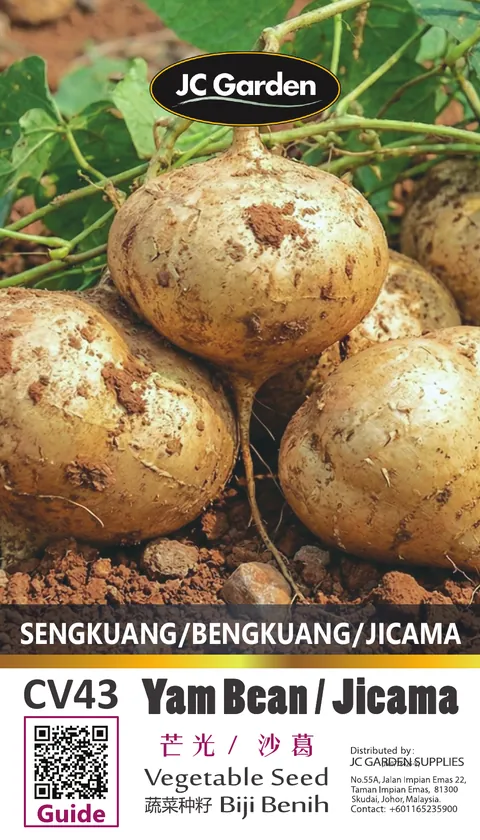
Yam Bean (Jicama) Seeds
Crunchy sengkuang roots for rojak, popiah and stir-fries — a long-season climbing vine that needs a trellis.
Training the vine and pinching flowers
Guide young vines onto the trellis; after that they twine up on their own.
After a couple of months the plant starts to send up flower spikes with small lilac or white flowers. Pinch these off as soon as you see them, and keep checking every few days. A plant left to flower and set pods puts its energy into seed, and the root stays small and fibrous. Pinching is the single biggest thing you can do for good-sized roots.
Need to work out poles and netting for your trellis?
Watering in hot and rainy weather
- First month: keep the soil evenly moist while seedlings establish.
- Root-swelling stage (from around month 2): water regularly and deeply during dry spells. Uneven watering — dry for days, then soaked — can make roots crack.
- Rainy season: this is when jicama is most at risk. Raised beds and free-draining pots are essential, because roots rot in waterlogged soil. Skip watering when the soil is still wet.
Mulch with dry grass or leaves to keep the soil surface cool and moist.
Feeding
Feed lightly in the first month with compost or a diluted balanced fertilizer to get the vine going. From about week 6, switch to a fertilizer with less nitrogen and more potassium, which supports root growth. Too much nitrogen gives a lush vine with disappointing roots.
Common problems and pests in Malaysia
- Root rot. Soft, smelly or collapsing roots after long wet spells. Prevention is better drainage: raised beds, sandy mix, no standing water.
- Small or woody roots. Usually flowers were not pinched, the soil was too hard or shallow, or too much nitrogen was used.
- Cracked roots. Irregular watering or a sudden heavy downpour after a dry spell. Water steadily and mulch.
- Aphids and spider mites. Curled or speckled leaves. Spray with water, then neem oil or a mild soap solution on the undersides of leaves.
- Leaf-eating beetles and caterpillars. Holes in leaves. Pick off by hand in the evening.
- Root-knot nematodes. Knobbly, galled roots. Rotate the bed and add plenty of compost; use fresh potting mix in containers.
Harvesting
Roots are usually ready around 4–5 months after sowing. Scrape the soil away from the top of one root to check its size; fist-sized or a little bigger is crisp and sweet, while very large old roots can turn starchy and fibrous. Loosen the soil around the plant with a fork and lift gently — the skin bruises easily.
Cut off the vine and dispose of it, together with any pods. Store whole roots in a cool, dry, shaded spot; once cut, wrap the pieces and refrigerate, using them within a few days. Peel off the brown skin before eating.
FAQ
Can I eat the young pods or leaves? No. Only the root is eaten. The seeds, pods, leaves and stems are poisonous.
Why is my jicama all vine and no root? Usually too much nitrogen, flowers left on the plant, or soil that is too hard. Next time pinch flowers early and switch to a higher-potassium feed from week 6.
Can I save my own seed? You can let one plant flower and set pods just for seed, but its root will be small. Dry the pods out of reach of children and pets.
What else grows well on a trellis here? Long beans and winged beans are faster crops for the same sunny fence: