
How to Grow Crown Daisy (Tong Ho) from Seed in Malaysia
How to grow small-leaf crown daisy (tong ho, daun kekwa) in Malaysia: sowing, afternoon shade, rain care, feeding, pests and harvesting young.
- Difficulty
- Medium
- Days to harvest
- 30–40 days
- Updated
- 2026-11-05
Yes, you can grow small-leaf crown daisy (tong ho, daun kekwa) in lowland Malaysia, but it is a cool-loving green, so it needs a little help. From seed you can harvest young plants in about 30–40 days. The one tip that matters most: give it morning sun and shade from the hot afternoon sun, and harvest young. In strong heat crown daisy rushes into flower, and once it flowers the leaves turn tough and bitter.
Quick facts
| Item | Small leaf crown daisy |
|---|---|
| Sun | Morning sun, shade from about 1 pm onwards in the lowlands |
| Sowing | 0.5 cm deep, cover lightly with fine soil |
| Germination | Usually 5–10 days |
| Spacing | Thin to 5 cm, then 10–15 cm |
| Days to harvest | About 30–40 days |
| Container | At least 15–20 cm deep; troughs, styrofoam boxes, wide pots |
| Support | Not needed |
| Temperature | Germinates best at 15–25°C; grows up to about 30°C |
Is it hard in lowland heat?
Honestly, it is medium difficulty. Crown daisy is grown widely in the Cameron Highlands because it likes cool nights. In Johor, KL or Penang it still grows, but on very hot days (above about 32°C) seedlings sulk and plants bolt early. You will get the best results if you:
- Sow in the slightly cooler months, roughly October to March, when there are more cloudy days.
- Keep it under a light shade net (about 50%) or on an east-facing balcony.
- Sow small batches every 2–3 weeks instead of one big sowing, so you always have young, tender plants.
- Expect smaller plants than highland bunches. The quick small-leaf type suits this well.
Choosing a spot and container
An east-facing balcony, a corridor that gets only morning sun, or a yard corner shaded by a wall in the afternoon is ideal. Avoid a west-facing balcony with a hot concrete floor unless you can put up shade cloth.
Crown daisy is shallow-rooted, so a long planter box, a styrofoam box with drainage holes or a 30 cm wide pot all work, with at least 15–20 cm of mix. Raise containers off hot tiles with bricks to keep roots cooler.
Soil and potting mix
It wants loose, moist soil rich in organic matter:
- 2 parts potting mix or loose garden soil
- 1 part compost
- 1 part cocopeat or burnt rice husk (sekam bakar)
Good drainage matters: soggy, airless mix leads to root rot and damping off.
How to sow crown daisy step by step
- Fill and water. Fill the container to 2 cm below the rim and water until it drains from the bottom.
- Sow thinly. Scatter seeds over the surface, or sow in shallow rows 10–15 cm apart. Aim for one seed every 1–2 cm.
- Cover lightly. Sprinkle about 0.5 cm of fine soil or cocopeat on top and press gently.
- Keep evenly moist. Water with a fine rose or spray bottle so the seeds are not washed out. A sheet of newspaper or shade cloth over the container for the first few days helps keep the surface from drying.
- Watch for seedlings. They usually appear in 5–10 days. Remove any cover as soon as they show.
- Thin in two steps. First thin to about 5 cm apart, then to 10–15 cm as plants grow. The thinnings are tender and edible.
Direct sowing works best. If you start seeds in trays, transplant while they are still small, with 3–4 true leaves, and do it in the evening.
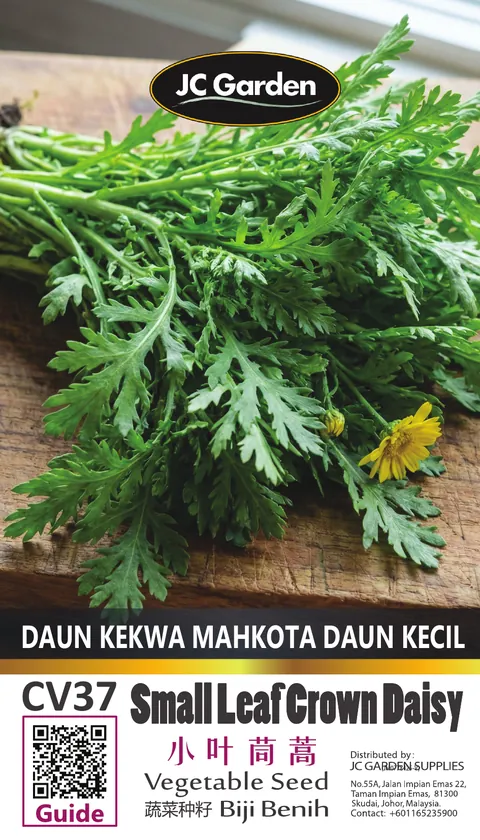
Small Leaf Crown Daisy Seeds
Fragrant small-leaf tong ho for steamboat, soups and stir-fries — quick to harvest, best with afternoon shade.
Watering in hot and rainy weather
- Hot, dry spells: check the mix morning and late afternoon. Crown daisy goes limp quickly in dry soil, and stress is what pushes it into flower. In shallow containers you may need to water twice a day.
- Rainy season: heavy rain flattens the soft stems and splashes mud onto the leaves. Move containers under the roof edge or put a clear plastic shelter over them, and make sure water drains away freely.
- Water at the base in the morning where possible, so the leaves dry before night.
Feeding
Crown daisy is a quick leafy crop, so it mainly needs gentle, regular nitrogen.
- Mix compost into the potting mix before sowing.
- About a week after the seedlings appear, start a weak liquid fertilizer.
- From about day 14, feed every 7 days at the dilution on the label.
Weaker and more often is safer than strong and rare.
Common problems and pests in Malaysia
- Bolting (early flowering). Yellow daisy-like flowers appear and the leaves turn tough. Caused by heat and drought stress. Harvest the whole batch, give more shade, and resow.
- Damping off and root rot. Seedlings collapse at the soil line, or older plants wilt even when the soil is wet. Use a well-drained mix, do not overwater, and avoid sowing too thickly.
- Aphids. Clusters of small soft insects on the shoots. Spray them off with water or use a diluted neem oil or mild soap spray in the evening.
- Leaf miners. Winding white trails inside the leaves. Pick off affected leaves early; fine insect netting keeps the adult flies away.
- Caterpillars and snails. Ragged holes after rain. Hand-pick in the evening with a torch.
For more organic options:
Harvesting
Start harvesting when plants are about 15–20 cm tall, usually 30–40 days after sowing.
- Whole plants: pull or cut entire young plants at the base, the way they are sold for steamboat.
- Second picking: cut stems just above the lowest 2–3 leaves. Side shoots grow back and can be picked again in 2–3 weeks, although in lowland heat the regrowth is often smaller and the plant may start flowering.
Harvest in the cool morning, rinse, and use soon. It is lovely in steamboat, clear soups and garlic stir-fries.
FAQ
Why are my plants flowering when they are still small? Heat and dry soil. In the lowlands this is common. Give afternoon shade, keep the mix moist, and sow a fresh batch every 2–3 weeks.
Can I grow it on a condo balcony? Yes, especially if it gets morning sun only. A styrofoam box or planter on a raised stand is enough for a family's steamboat greens.
What else grows well with only morning sun? Lettuce and pak choy also appreciate afternoon shade in the lowlands: