
How to Grow Sunflowers (Bunga Matahari) in Pots in Malaysia
How to grow sunflowers in Malaysia: dwarf pot varieties vs tall types, direct sowing, keeping birds off, staking, feeding, rain care and harvesting seeds.
- Difficulty
- Easy
- Days to harvest
- 60–80 days
- Updated
- 2026-11-04
Yes, sunflowers (Helianthus annuus, bunga matahari) grow very well in lowland Malaysia. They love heat and strong sun, and most varieties flower about 60–80 days after sowing. Dwarf varieties are the best choice for balconies and pots, while tall types suit a terrace-house yard where they can reach 1.5–3 m. The one tip that matters most: sow the seed directly where it will grow and protect it from birds and squirrels for the first two weeks, because they dig up and eat freshly sown seeds and young seedlings.
Quick facts
| Item | Sunflower |
|---|---|
| Sun | Full sun, 6–8 hours; less sun gives weak, leaning stems |
| Sowing depth | 2–3 cm |
| Germination | 5–10 days |
| Spacing | Dwarf 20–30 cm; tall 45–60 cm |
| Days to flower | About 60–80 days (dwarf types often sooner) |
| Container | Dwarf: 20–25 cm pot (5–10 L); tall: 20 L or more, or in the ground |
| Support | Dwarf types usually none; tall types need a strong stake |
Dwarf or tall: which to grow
Dwarf sunflowers grow about 30–90 cm tall, usually on a single stem with one main flower, sometimes with a few smaller side flowers. They fit a balcony railing, a porch step or a row of pots, and rarely need staking. Many ornamental dwarf and cut-flower types are bred to be pollen-free, so they do not drop yellow pollen on floors, but they also will not set seed unless pollen from another sunflower reaches them.
Tall sunflowers reach 1.5–3 m and carry big heads. They need deep soil, a strong stake and shelter from strong wind. Grow them in the ground or a large container in a yard. Tall seed types are the ones to grow if you want to harvest seeds for snacking or for birds.
Choosing a spot and container
Sunflowers need the sunniest place you have. Flower buds turn to follow the sun while they are young; once open, most flowers face roughly east. Plant them where you will see the flower face, not the back of the head.
On a condo balcony, check how much weight your railing planters and the floor can carry. A big pot of wet soil is heavy:
Soil and potting mix
Sunflowers like a deep, loose, well-drained mix:
- 2 parts potting mix or garden soil
- 1 part compost
- 1 part burnt rice husk (sekam bakar) or coarse sand
Loosen garden soil at least 30 cm deep for tall types. Avoid waterlogged corners; sunflower roots and stem bases rot in soggy soil.
How to sow sunflowers step by step
- Sow directly. Sunflowers grow a long taproot and dislike being moved. If you must start them in cups, use deep ones and transplant within 2 weeks.
- Water the pot or bed first so the soil is evenly moist.
- Push seeds in 2–3 cm deep, pointed end down, 2 seeds per spot.
- Cover and firm the soil lightly.
- Protect from birds and squirrels. Cover with netting, an upturned basket or cut plastic bottles until seedlings have 4 true leaves.
- Keep moist but not soggy. Seedlings appear in 5–10 days.
- Thin to the strongest seedling at each spot once true leaves appear.
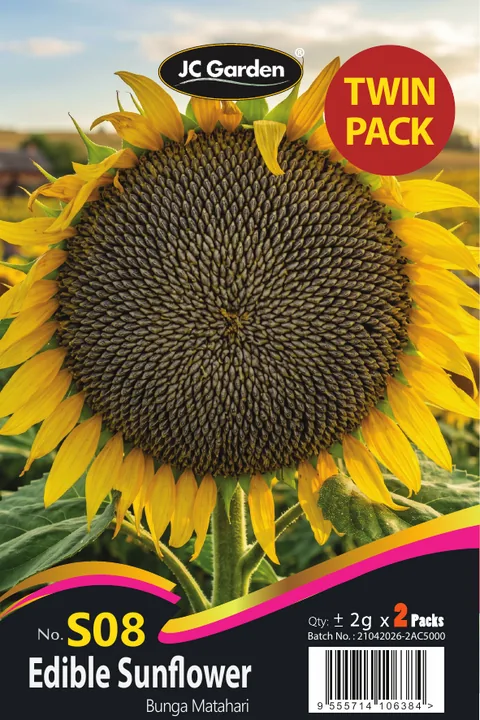
Edible Sunflower Seeds
Heat-loving sunflowers for pots and yards — sow direct, keep birds off, and enjoy flowers in about 60–80 days.
Support and pruning
Tall varieties need a bamboo or wooden stake pushed in at sowing time, about 15 cm from the seed, so you do not damage roots later. Tie the stem loosely every 30 cm as it grows. Heavy heads plus afternoon thunderstorms are what topple most sunflowers.
Single-stem types need no pruning. Branching types can be pinched once when young for more, smaller flowers.
Watering in hot and rainy weather
- Hot spells: water deeply in the morning. Big plants in pots can drink a lot and may need water every day once flowering. A layer of mulch helps.
- Rainy season: make sure pots drain freely and are raised off the floor. Long wet weeks can rot flower heads from the back. If a head starts to turn brown and mushy, cut it off.
- Water the soil, not the leaves and heads.
Feeding
Mix compost into the soil before sowing. About 3 weeks after germination, scatter a small handful of NPK granules around the plant (not against the stem) and water in, repeating once when buds form. Too much nitrogen makes tall, soft stems that fall over.
Pollination and seeds
Each sunflower head is made of hundreds of tiny florets that open in rings from the outside in. Bees, including small native bees, visit them readily. For seed, a variety that produces pollen is needed.
Common pests and problems in Malaysia
- Birds and squirrels. Eat sown seeds, seedlings and ripening seed heads. Net seedlings; cover ripening heads with a mesh bag or a paper bag tied loosely.
- Caterpillars. Chew leaves and sometimes bore into heads. Hand-pick, and check under leaves.
- Aphids and mealybugs. On stems and under leaves. Hose off or spray diluted neem oil in the evening.
- Snails. Feed on young seedlings after rain. Pick off at night.
- Leaf spots and mildew. In humid, crowded plantings. Space plants and remove lower spotted leaves.
- Stem base or head rot. Usually wet soil or long rain. Improve drainage and harvest early.
More organic fixes:
Harvesting flowers and seeds
For a vase: cut in the morning when the petals are just starting to open, with clean shears. Strip most leaves and put stems straight into water.
For seeds: wait until the back of the head turns from green to yellow-brown and the petals have dried and fallen. Cover the head with a mesh or paper bag to keep birds off, cut it with 30 cm of stem, and hang it upside down in a dry, airy spot until the seeds loosen. Rub them out with your hand. Seeds from pollen-free ornamental varieties often stay empty.
Sunflower petals and mature seeds are edible, so if you grow them without chemical sprays you can also use them in the kitchen:
FAQ
Can I grow sunflower microgreens instead? Yes. Young sunflower shoots are a popular microgreen, harvested about 1–2 weeks after sowing. Use seeds sold for microgreens or sprouting, not seeds that have been treated for sowing outdoors:
Why is my sunflower bending over? Usually not enough sun (it stretches towards the light), wind, or a heavy head on a soft stem. Move it to full sun and stake tall types early.
Will a sunflower flower again after I cut it? Single-stem varieties produce one main flower and then finish. Branching types keep producing smaller flowers for a few weeks. For a longer display, sow a few seeds every 2–3 weeks.
When is the best time to sow? Sunflowers can be sown in most months, but heads rot in long wet spells. On the west coast, aim for flowering outside the heaviest rains; on the east coast, avoid flowering from November to January unless under shelter.