
How to Grow Cauliflower in Lowland Malaysia (An Honest Guide)
Can cauliflower (kubis bunga, 花椰菜) grow in lowland Malaysia? Tropical varieties, best months Nov–Feb, rain shelter, blanching, pests and what to expect.
- Difficulty
- Harder
- Days to harvest
- 80–100 days
- Updated
- 2026-11-04
Honest answer: cauliflower (kubis bunga, 花椰菜) is one of the hardest vegetables to grow in lowland Malaysia. It needs cool nights to form a good white head (the "curd"), and in steady 30 °C+ heat many plants either make only leaves, form tiny "button" heads, or produce loose, fuzzy curds that quickly turn yellow. Commercial cauliflower in Malaysia comes mainly from the highlands. If you want to try in the lowlands, use a heat-tolerant tropical variety, sow so the plants head during the slightly cooler nights of roughly November to February, and keep monsoon rain off them. Heads typically take about 80–100 days from sowing and will be smaller than shop cauliflower — treat any head as a bonus. The one key tip: never let the plant stall. Any check in growth — dry soil, root-bound seedlings, hunger — is what turns a lowland cauliflower into a button.
Quick facts
| Item | Cauliflower |
|---|---|
| Sun | 5–6 hours; full morning sun, some afternoon shade in the lowlands |
| Sowing depth | About 0.5 cm |
| Germination | 4–7 days |
| Spacing | 45–50 cm between plants |
| Days to harvest | About 80–100 days from sowing (tropical varieties) |
| Container | At least 30 cm deep, around 20–25 litres per plant |
| Support | None; insect netting and rain shelter strongly recommended |
Lowland or highland: what to expect
- Variety is everything. Choose seed described as heat-tolerant, tropical or early. Cool-climate varieties sold for temperate countries rarely head in the lowlands.
- Timing. In Peninsular Malaysia, sowing from about October to December puts heading in the cooler nights of December to February. On the east coast that is also peak monsoon, so a roof or rain shelter becomes essential.
- Highland gardeners (Cameron Highlands, Genting, Kundasang) have a much easier time and can sow most of the year.
- Plan B. If no head forms, the leaves are edible, cooked like kailan or cabbage leaves.
If you want a reliable brassica harvest in the lowlands, kailan is a far safer choice:
Spot and container
Give cauliflower the brightest morning sun you have, with shade from mid-afternoon and, ideally, a roof or clear rain shelter overhead. A terrace-house porch or yard is better than a high condo balcony, where wind and reflected heat dry the plants quickly.
Grow one plant per large polybag or pot of about 20–25 litres and at least 30 cm deep, or 45–50 cm apart in a bed. Small pots almost always give button heads. Check balcony loading before filling several large pots:
Soil and potting mix
Cauliflower needs rich, deep, moisture-holding soil:
- 2 parts loose garden soil or potting mix
- 1 part compost or well-rotted manure
- A handful of burnt rice husk or cocopeat
Mix in garden lime a week or two before planting if your soil is acidic; brassicas grow best close to neutral, and lime lowers club root risk. Use fresh soil, not soil from last season's brassicas.
How to sow cauliflower step by step
- Sow in a seedling tray with fine, moist seed-starting mix.
- Sow 1–2 seeds per cell, about 0.5 cm deep, and cover lightly.
- Keep moist in bright shade. Seedlings appear in 4–7 days.
- Move into morning sun straight away so seedlings are short and strong.
- Thin to one per cell by snipping the weaker one.
- Keep the tray under insect netting to stop flea beetles and moths.
- Transplant at 4–5 true leaves, around 3–4 weeks after sowing. Do not hold seedlings longer — root-bound cauliflower seedlings are a classic cause of button heads.
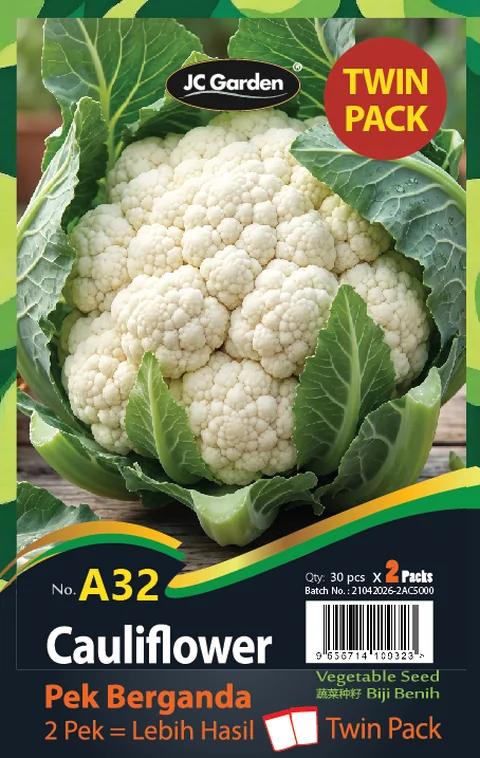
Cauliflower Seeds
A challenge in the lowlands — sow Oct–Dec so heads form in cooler Nov–Feb nights; easier in the highlands.
Transplanting
Plant in the late afternoon, up to the first leaves, firm the soil and water well. Shade for 2–3 days and put netting back on at once. Mulch the soil with straw or dry leaves to keep roots cool and moist.
Blanching the head
When a small curd the size of a coin appears in the centre, it needs protection from strong sun or it turns yellow or purple-tinged and loses quality. Fold a few large inner leaves over the curd and tie them loosely with soft string or a peg. Check under the leaves every couple of days for caterpillars and rot. Some varieties have leaves that curl over the head naturally.
Watering in hot and rainy weather
- Hot weather: water deeply every morning and check again in the afternoon. Cauliflower must never dry out; even one wilting day can stunt the curd.
- Rainy season: keep plants sheltered from heavy rain. Water collecting in the curd leads to rot. Make sure containers drain freely and remove yellow lower leaves.
- Water at the base only.
Feeding
Mix compost into the planting hole. Two weeks after transplanting, feed a balanced granular NPK every 2–3 weeks or a diluted liquid fertilizer every 7–10 days. Top up with compost on the surface monthly. Cauliflower is sensitive to boron and molybdenum shortages, which show as hollow stems or narrow, strap-like leaves; plenty of good compost and a fertilizer that lists trace elements help prevent them.
Common pests and diseases in Malaysia
- Diamondback moth caterpillars. Small green caterpillars that wriggle and drop on a thread, chewing windows in leaves and hiding in the curd. Netting from day one; check undersides every few days; hand-pick; spray neem oil or a Bt (Bacillus thuringiensis) product in the evening if needed.
- Cluster caterpillars and webworm. Caterpillars feeding in groups or webbing the growing point. Remove by hand when you see them.
- Flea beetles. Tiny jumping black beetles that riddle seedlings with holes. Netting and fast early growth protect them.
- Aphids. Hiding in the curd and under leaves. Hose off and spray neem or mild soap.
- Soft rot. Brown, mushy, smelly patches on the curd or stem, worst in wet weather. Keep rain off, harvest promptly and bin infected plants.
- Black rot and downy mildew. V-shaped yellow patches from the leaf edge, or yellow patches with fuzz beneath. Remove affected leaves and avoid wetting foliage.
- Club root. Stunted plants wilting on hot afternoons, with swollen roots. Remove, bin and use fresh limed soil next time.
Harvesting
Cut the head while it is still tight, white and smooth — usually 1–2 weeks after the curd first appears in lowland heat, often sooner than you expect. If the curd starts to separate, look grainy or "ricey", or show tiny leaves poking through, harvest immediately; it will not improve. Cut the stem below the head with a few leaves attached to protect it.
FAQ
Why did my cauliflower make a tiny head? That is "buttoning", caused by stress: heat, drought, hunger, or seedlings left too long in the tray. Transplant young, keep soil moist and feed steadily.
Why is the curd yellow or purple? Sun exposure. Blanch by tying the leaves over the curd as soon as it appears.
My plants are huge but there is no head. Will it come? In lowland heat, sometimes it never does. If nothing has appeared well past the expected time, harvest the leaves and try again in the cooler months with a tropical variety.
Is broccoli easier? Slightly, because broccoli gives side shoots even when the main head is small: