
How to Grow Asparagus from Seed in Malaysia (A Long-Term, Honest Guide)
Grow green asparagus from seed in lowland Malaysia: a perennial taking 2–3 years to first harvest. Raised beds, drainage, mother ferns and cutting spears.
- Difficulty
- Harder
- Days to harvest
- 730+ days
- Updated
- 2026-11-05
Honest answer: green asparagus can grow in lowland Malaysia, but it is a long-term perennial, not a quick vegetable. From seed it takes 2–3 years before your first proper harvest of spears. In the first year the plant grows only fine, feathery ferns that build up an underground crown of roots; you cut spears only once that crown is strong. After that, a well-kept bed can produce for many years. The one key tip: drainage. In our heavy rain, waterlogged soil rots the crowns, so grow asparagus in a raised bed or a very large pot with sandy, compost-rich soil.
Quick facts
| Item | Green asparagus |
|---|---|
| Sun | Full sun, 6 hours or more |
| Sowing | Soak seed 24 hours; sow 1.5–2 cm deep |
| Germination | 10–21 days, often uneven |
| Spacing | 30–45 cm between crowns in a permanent bed |
| Time to harvest | First light harvest in year 2–3, then for many years |
| Container | Seedlings: deep pots or polybags; adults: a raised bed, or a pot of at least 40 cm deep and wide |
| Support | No trellis; a few stakes or a string fence stop tall ferns flopping |
Is it worth it?
Asparagus suits gardeners with patience and a sunny spot they can give up permanently. A single crown produces a modest number of spears at a time, so for regular meals you need several plants. In the tropics the plant does not go dormant in winter, so instead of one spring season, growers keep some ferns standing all the time (the "mother ferns") and harvest new spears in rounds. Expect a steady trickle rather than a glut.
Choosing a spot
Choose the sunniest place you have, with at least 6 hours of direct sun. The ferns grow 1–1.5 m tall, so put the bed where they will not shade other crops. Do not plant where water collects after rain. In a terrace-house yard a raised bed 20–30 cm high is ideal. On a balcony, one or two crowns in very large pots are possible, but yields are lower.
Soil
Asparagus wants deep, loose, well-drained soil that stays fertile for years:
- 2 parts sandy garden soil or loam
- 1 part compost or well-rotted manure
- 1 part coarse sand or burnt rice husk (sekam bakar)
Dig the bed at least 30–40 cm deep and remove weeds with running roots, such as lalang, before planting; they are hard to remove from a permanent bed later. Asparagus dislikes very acidic soil, so a little garden lime mixed in helps if your soil is acidic.
How to sow asparagus step by step
- Soak the seeds in clean water for 24 hours. The seed coat is hard and soaking speeds germination.
- Fill deep pots or polybags with a light seedling mix. Asparagus forms long roots early, so avoid shallow trays.
- Sow 1–2 seeds per pot, 1.5–2 cm deep, and cover.
- Keep warm and moist in bright shade or morning sun. Seeds germinate best at around 24–30 °C.
- Be patient. Germination takes 10–21 days and is often uneven, so do not tip out a pot that looks empty after one week.
- Thin to the strongest seedling once the first thin fern-like stems are up.
- Grow on for 3–4 months, feeding lightly, until each seedling has several stems.
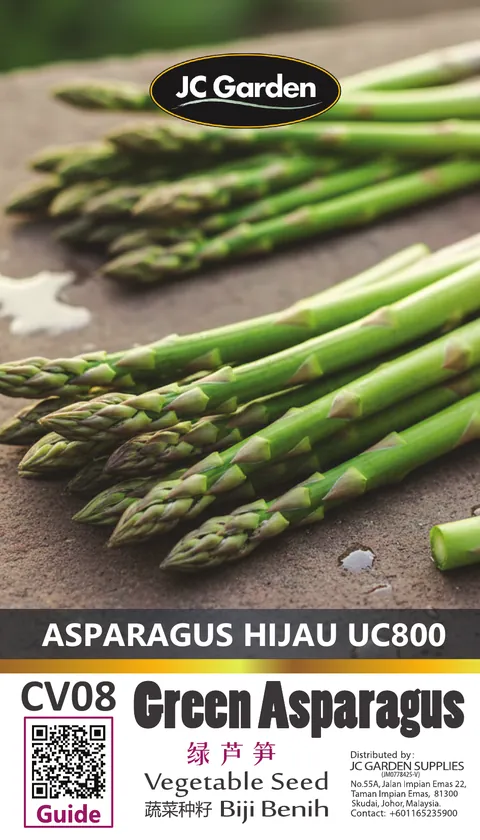
Green Asparagus UC800 Seeds
Long-lived perennial vegetable — slow to start (2+ years to first spears) but crops for many years.
Planting into the permanent bed
After 3–4 months, plant the seedlings 30–45 cm apart in the raised bed, setting the crown slightly below the soil surface. Water in well and mulch with 5 cm of dried leaves, straw or compost.
Year one: let every stem grow into ferns and do not harvest at all. The ferns make the food that is stored in the crown. Weed carefully by hand, because roots near the surface are easily damaged.
Watering in hot and rainy weather
- Dry spells: water deeply once or twice a week rather than a little every day, so roots go deep. Keep a thick mulch.
- Rainy season: check that no water stands on the bed after storms. If it does, raise the bed or improve the drainage channels around it.
- Water at the base in the morning so the ferns dry quickly.
Feeding
Apply compost or an organic fertilizer every 4–6 weeks, and give an extra feed after each harvesting period to rebuild the crown. Top up the mulch with compost a few times a year.
Male and female plants
Asparagus plants are either male or female. Female plants produce small green berries that turn red; these use energy and drop seeds that sprout as weeds in the bed. Pick the berries off, or, if you have plenty of plants, keep mostly the males, which usually make more spears. The berries are not edible.
Common pests and diseases in Malaysia
- Crown and root rot. The most common failure, caused by waterlogging. Plants yellow and collapse. Prevention is the cure: raised beds and sandy soil.
- Stem blight and fungal spots in wet weather. Brown or purple spots and lesions on stems and ferns. Cut out affected stems, keep the bed weeded for airflow, and avoid evening watering.
- Caterpillars, thrips and aphids. They feed on the ferns and young spears. Pick off caterpillars and use a neem or mild soap spray in the evening.
- Red spider mites. Fine webbing and pale speckled ferns in hot, dry weather. Spray the ferns with water and keep them watered.
Harvesting
From the second or third year, when the crown sends up spears as thick as a pencil or thicker:
- Cut spears when they are 15–20 cm tall and the tip is still tight, with a sharp knife at or just below soil level.
- Always leave 3–5 healthy ferns standing on each crown to keep feeding it.
- Harvest lightly in the first season, for a few weeks only.
- Stop and let spears grow into ferns once new spears come up thinner than a pencil.
Spears grow fast in warm weather, so check every day or two during a harvest round.
FAQ
Why do I need to wait two or more years? The spears you eat come from energy stored in the crown. Cutting too early weakens it and the plant may never produce well.
Can I grow asparagus in a pot? Yes, in a pot at least 40 cm deep and wide, one crown per pot. Expect smaller harvests than in a bed.
What can I grow while waiting? Quick crops grown in separate beds, such as okra or long beans, fill the gap: