
How to Grow Zucchini in Malaysia: Containers, Rain Shelter and Hand Pollination
How to grow zucchini in lowland Malaysia: big containers, rain shelter, hand pollination, stopping powdery mildew and picking fruit young.
- Difficulty
- Harder
- Days to harvest
- 45–60 days
- Updated
- 2026-11-05
Zucchini can be grown in lowland Malaysia, but honestly it is a crop bred for temperate summers, not our hot afternoons and heavy rain. The first fruit is usually ready about 45–60 days after sowing, yet many home growers get plenty of flowers and few fruit, or leaves turning white with powdery mildew within weeks. The one tip that matters most: hand pollinate every female flower early in the morning, and keep the plant under a rain shelter in a big container. Expect a short, productive season of a few weeks rather than months of harvest.
Quick facts
| Item | Zucchini |
|---|---|
| Sun | Full sun, at least 6 hours; light afternoon shade helps on very hot balconies |
| Sowing depth | 2–3 cm, seed placed on its edge |
| Germination | 4–8 days |
| Spacing | One plant per container; 70–90 cm between plants in the ground |
| Days to harvest | About 45–60 days from sowing |
| Container | At least 40–50 litres, 40 cm deep and wide (one plant) |
| Support | Not essential for bush types; a stake keeps the stem upright in wind |
Is it worth trying? Best months and tactics
Zucchini struggles here for three reasons. Very hot days reduce pollen quality and can make the plant produce mostly male flowers. Rain keeps flowers closed, washes pollen away and keeps bees at home, so the tiny fruit shrivel unpollinated. And humid, still air is perfect for powdery mildew. To tilt the odds:
- Sow for a drier spell. On the west coast of the Peninsula, sowings in January–February and May–August often meet fewer rainy weeks during flowering. On the east coast, avoid the northeast monsoon (roughly November to March).
- Use a rain shelter: a clear roof, covered porch edge or sunny balcony.
- Sow small batches a few weeks apart, so at least one batch flowers in better weather. (Highland growers, such as in Cameron Highlands, will find zucchini far easier.)
Choosing a spot and container
One zucchini plant can spread 80–100 cm across. Choose a spot with morning sun, good airflow and shelter from heavy rain; on a condo balcony, near the railing but under the overhang. Use one large container per plant: a 40–50 litre grow bag, a big tub or a recycled paint bucket with drainage holes. Small pots dry out by midday. Wet soil is heavy, so check the weight before lining up several on a balcony:
Soil and potting mix
Zucchini needs a rich, loose mix that holds water but drains freely:
- 2 parts potting mix or good garden soil
- 1 part compost or well-rotted manure
- 1 part cocopeat or burnt rice husk (sekam bakar) for drainage and air
Mix in a handful of organic or slow-release fertilizer, and leave 3–5 cm below the rim for compost top-ups.
How to sow zucchini step by step
- Sow where it will grow. Zucchini dislikes root disturbance. Sow directly into the final container, or into a small pot you can transplant from very gently.
- Water the mix first. Fill and water the container until water runs out of the base.
- Plant 2 seeds per container, 2–3 cm deep, on their narrow edge so they are less likely to rot.
- Cover and firm lightly. Keep the mix moist but not soggy. In heavy rain, cover the container or move it under shelter until seedlings appear.
- Seedlings appear in 4–8 days.
- Thin to one plant when the first true leaf opens. Snip the weaker seedling at soil level with scissors instead of pulling it out.
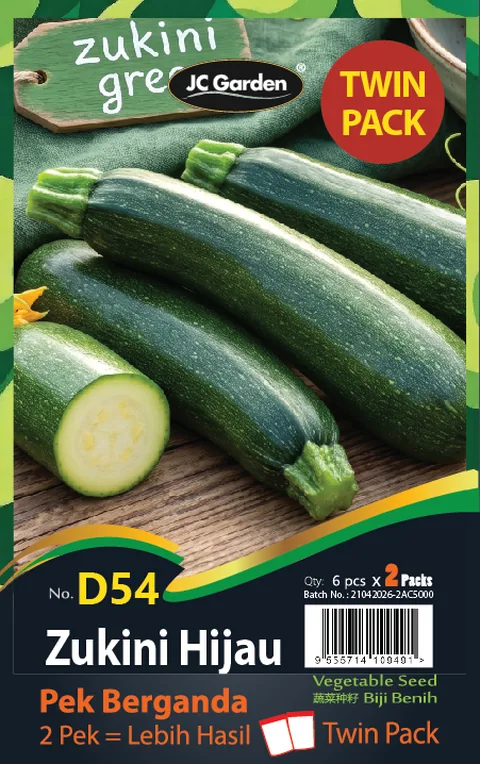
Green Zucchini Seeds
JC Garden seed twin pack (2 packets). See the pack for sowing details.
Transplanting and support
Move pot-started seedlings into the big container at 2 true leaves, keeping the root ball intact and planting at the same depth. Transplant in the late afternoon and give light shade for 2–3 days.
Bush zucchini needs no trellis, but the stem leans as it gets heavy. Push in a sturdy stake at planting and tie the stem loosely as it grows. Remove yellowing or mildewed lower leaves for airflow, but keep plenty of healthy ones to feed the fruit.
Flowering and hand pollination
Zucchini has separate male and female flowers. Male flowers sit on a thin stalk and usually appear first, often a week or more before the females. Female flowers have a small zucchini behind the petals; if not pollinated, it turns yellow and drops within a few days.
Flowers open at dawn and close by late morning, so pollinate early:
- Between about 7 and 9 am, pick a freshly opened male flower.
- Peel back its petals to expose the pollen-covered centre.
- Brush it gently against the centre of an open female flower, covering it with pollen. You can also use a small soft paintbrush.
- One male flower can pollinate one or two females.
A pollinated fruit starts swelling within a day or two.
Watering in hot and rainy weather
- Hot spells: water deeply every morning. Big leaves may droop in the afternoon even in moist soil; water again only if the top 2–3 cm of mix is dry.
- Rainy weeks: do not water if the mix is still damp. Waterlogged roots rot quickly.
- Always water at the base, never over the leaves. Wet leaves spread mildew.
- Keep watering even. Swinging between bone-dry and soaked can cause fruit to rot from the tip.
Feeding
Feed a balanced liquid fertilizer every 7–10 days from 3–4 true leaves. When flowers appear, switch to a formula with more potassium (K) than nitrogen (N) to support flowering and fruit. Add a thin layer of compost on top every few weeks. Too much nitrogen gives huge leaves, more mildew and fewer fruit.
Common pests and diseases in Malaysia
- Powdery mildew. White, flour-like patches on the leaves, very common here. Space plants, water the soil not the leaves, and remove the worst leaves. Spray neem oil or a weak baking soda solution every 5–7 days at the first sign, testing on a few leaves first.
- Downy mildew. Yellow, angular patches with grey growth below, worst in long rain. Remove affected leaves and keep the plant under shelter.
- Pumpkin beetle. Orange beetles that chew round holes in leaves and flowers and can strip seedlings. Pick off in the cool early morning and cover seedlings with netting.
- Fruit fly. Stings young fruit, which then rot. Pick fruit young and remove any damaged ones. Fruit fly traps help.
- Aphids, whitefly and thrips. Sap-suckers on the leaf undersides that can spread virus (mottled, crinkled leaves). Hose them off, hang yellow sticky traps and spray neem oil in the evening.
- Young fruit rotting at the tip. Usually poor pollination or uneven watering.
Harvesting
Pick zucchini young, at about 15–20 cm long and still glossy, usually only 4–7 days after pollination, so check daily. Cut with a knife, leaving a short stalk. Young fruit taste best, and frequent picking keeps the plant flowering. Male flowers are edible too once you have used them for pollination.
FAQ
Why does my zucchini have lots of flowers but no fruit? They are probably male flowers, or female flowers that were not pollinated. Wait for females to appear, then hand pollinate early in the morning.
Can I grow zucchini on a condo balcony? Yes, with 6 hours of sun and a 40–50 litre container. Rain-sheltered balconies often beat open gardens.
Why are the leaves turning white? That is powdery mildew. Improve airflow, keep leaves dry and spray neem oil early. Some mildew late in the season is normal.
Is there something easier that gives a similar harvest? Cucumber and pumpkin cope much better with lowland heat and rain: