
How to Grow Watermelon (Tembikai) at Home in Malaysia
How to grow watermelon in Malaysia: space, ground vs trellis with slings, hand pollination, stopping fruit cracking after rain, pests and ripeness signs.
- Difficulty
- Medium
- Days to harvest
- 70–90 days
- Updated
- 2026-11-04
Yes — watermelon (tembikai) loves Malaysia's heat and strong sun, and most varieties are ready about 70–90 days after sowing. The catch is space: vines run 2–3 m, so it suits a terrace-house yard or a large, sunny roof terrace more than a small balcony. Grow it on the ground with a thick mulch, or up a strong trellis with each fruit held in a sling — on a trellis, choose small "mini" or icebox-type varieties. The one key tip: help pollination by hand in the morning, and cut back watering as the fruit ripens, because heavy rain on nearly ripe fruit is the main cause of cracking and bland flavour.
Quick facts
| Item | Watermelon |
|---|---|
| Sun | Full sun, 8 hours or more |
| Sowing depth | 2–3 cm |
| Germination | 4–8 days |
| Spacing | On the ground 1–1.5 m between plants; on a trellis 60–80 cm |
| Days to harvest | About 70–90 days from sowing; roughly 30–45 days after pollination |
| Container | At least 50 L per plant, or plant in the ground |
| Support | Ground with mulch, or a strong trellis with fruit slings |
Choosing a spot and growing method
Pick the sunniest, most open spot you have; in shade watermelon makes leaves and few fruits.
On the ground (simplest): let the vines run over a mulched patch. Lay dried grass, straw, rice husk or plastic mulch so fruits sit on a dry surface. Raise the planting spot slightly into a mound so water drains away after storms.
On a trellis (saves space): use a sturdy frame at least 1.5–2 m tall made of strong poles and wire or heavy netting. Choose small-fruited varieties. As each fruit reaches tennis-ball size, support it in a sling made of mesh bag, old netting or cloth tied firmly to the frame, so the weight hangs on the trellis and not on the stem.
Containers: use a large tub or polybag of 50 L or more, one plant per container, and train it up a trellis. Check that your balcony or roof can take the weight of wet soil and growing fruit:
Soil and potting mix
Watermelon likes loose, sandy, well-drained, rich soil:
- 2 parts sandy garden soil or potting mix
- 1 part compost or well-rotted manure
- 1 part burnt rice husk (sekam bakar) or cocopeat
Mix in balanced granular fertilizer at planting at the label rate. Avoid planting where cucumber, melon or pumpkin grew recently, to reduce soil-borne disease.
How to sow watermelon step by step
- Sow directly or in cups. Watermelon dislikes root disturbance. Sow 2 seeds per spot directly, or one seed per deep cup if you want to protect seedlings from rain and pests.
- Sow 2–3 cm deep, pointed end down or on the side, and cover.
- Keep warm and lightly moist. Too much water rots the seed. Seedlings appear in 4–8 days.
- Thin to one strong seedling per spot.
- Transplant cup seedlings early, at 2–3 true leaves (about 2 weeks), without breaking the root ball. Water well and shade lightly for 2 days.
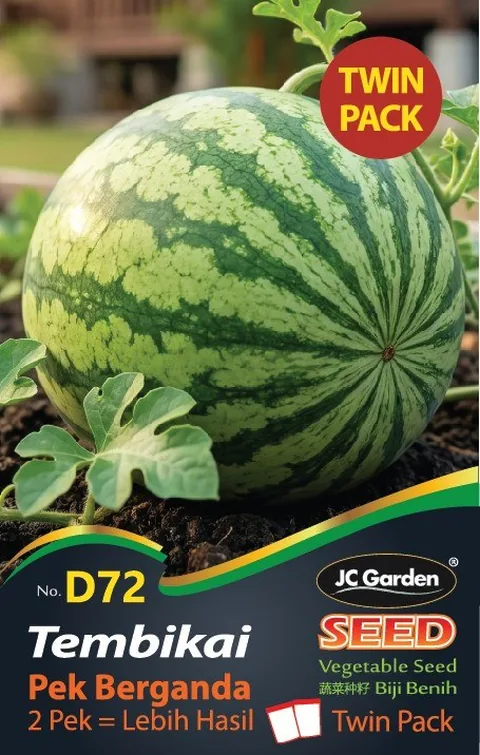
Watermelon Seeds
Sun-loving watermelon for yards and big terraces — grow on mulched ground or a strong trellis with slings.
Training and pruning
On the ground, many growers keep the main vine plus 2–3 strong side vines and remove the rest, so the plant puts energy into fewer, better fruits. On a trellis, tie the main stem up and remove side shoots on the lower part of the plant; let fruit set on side vines higher up.
Limit fruits: keep 1–2 fruits per plant for large types, 2–3 for mini types, and remove extras while they are small. A well-fed plant with fewer fruits gives sweeter, bigger melons.
Watering in hot and rainy weather
- Seedling to flowering: keep the soil evenly moist; water deeply in the morning at the base, not over the leaves.
- Fruit swelling: this is when the plant needs the most water. Do not let it dry out, or fruit stays small.
- Last 7–10 days before ripening: reduce watering. This improves sweetness.
- Rainy weather: cracking happens when a nearly ripe fruit suddenly takes up a lot of water after heavy rain. Keep moisture as even as possible, mulch well, make sure the ground drains, and, if you can, put a simple rain cover over the plant in the final weeks. Sow so that ripening falls in a drier period — the calendar avoids the wettest months for this reason.
Feeding
- At planting: compost plus balanced granular fertilizer.
- Vine growth: a balanced fertilizer every 2–3 weeks at the label rate.
- From flowering and fruit set: switch to a fertilizer with more potassium (K) than nitrogen (N) to improve fruit size and sweetness.
Too much nitrogen gives a jungle of leaves and few fruits.
Flowering and hand pollination
Watermelon has separate male and female flowers on the same plant. Male flowers come first, on thin stalks. Female flowers have a tiny, striped baby melon behind the petals. Bees normally pollinate them, but on balconies, rooftops or after rain there may be few bees.
To hand-pollinate:
- Do it in the morning, ideally 7–10 am, when flowers are freshly open.
- Pick a male flower and peel back its petals.
- Gently brush its pollen onto the centre of a female flower.
- Use one male flower for one or two female flowers.
A successfully pollinated baby fruit swells within a few days; an unpollinated one turns yellow and drops. Note the date — it helps you judge ripeness later.
Common pests and diseases in Malaysia
- Fruit flies. Maggots inside young fruit. Wrap young fruits in paper or mesh bags soon after they set, and use fruit fly traps nearby.
- Red pumpkin beetle. Orange beetles chewing holes in leaves, especially on young plants. Hand-pick in the early morning and protect seedlings with netting.
- Aphids, thrips and whiteflies. Curling, mottled leaves and spread of viruses. Spray neem oil in the evening and remove badly virus-affected plants.
- Downy and powdery mildew. Yellow patches or white powder on leaves, common in humid, rainy weather. Space plants, water at the base in the morning and remove badly affected leaves.
- Fruit rot. Soft patches where fruit touches wet soil. Keep fruits on dry mulch, a tile or a slab of styrofoam.
- Sudden wilting. Can be fusarium wilt or stem rot; remove affected plants and rotate planting spots.
More organic options:
Harvesting
Watermelons do not ripen further after picking, so timing matters. Check these signs together:
- The curly tendril nearest the fruit has turned brown and dry.
- The patch where the fruit rests on the ground has changed from white to creamy yellow.
- The rind has turned from glossy to dull, and is hard to dent with a fingernail.
- About 30–45 days have passed since pollination, depending on variety.
Cut the stem with shears, leaving a short piece attached.
FAQ
Why do my baby watermelons turn yellow and fall off? They were not pollinated. Hand-pollinate in the morning, and make sure the plant is not stressed by dry soil.
Why did my watermelon split? A sudden large intake of water near ripening, usually after heavy rain following a dry spell. Water evenly and reduce watering in the final 7–10 days.
Can I grow watermelon on a condo balcony? Only if it is large, very sunny and can take the weight. Grow one mini variety in a 50 L container on a strong trellis with slings.
Why is my watermelon not sweet? Too little sun, too many fruits per plant, too much water near ripening, or picking too early.