
How to Grow Portulaca (Bunga Ros Jepun) from Seed in Malaysia
How to grow portulaca (moss rose, bunga ros jepun) in Malaysia: surface-sowing tiny seeds in light, gritty soil, watering, rain care, cuttings and pests.
- Difficulty
- Easy
- Days to harvest
- 50–70 days
- Updated
- 2026-11-04
Yes, portulaca (Portulaca grandiflora, moss rose, bunga ros jepun) is one of the best flowers for hot, sunny spots in lowland Malaysia. It thrives on heat, strong sun and dry soil that would cook most other plants, and from seed it usually starts flowering in about 7–10 weeks. The one tip that matters most: the seeds are tiny and need light to germinate, so press them onto the surface of the mix and do not bury them. After that, the main way people kill portulaca is by watering it too much.
Quick facts
| Item | Portulaca |
|---|---|
| Sun | Full sun, 6 hours or more; flowers stay closed in shade |
| Sowing depth | Surface-sow; press in, do not cover |
| Germination | 7–14 days in warm conditions |
| Spacing | 15–20 cm |
| Days to flower | About 50–70 days from sowing |
| Container | Shallow pots, troughs or hanging baskets, 10–15 cm deep |
| Support | None; it trails and spreads |
Choosing a spot and container
Give portulaca the hottest, sunniest place you have: a west-facing balcony ledge, the top of a wall, a sunny porch step or the edge of a driveway bed. The flowers open in bright sun and close in the late afternoon or on cloudy days, so the more direct sun, the more colour you see.
Because it is shallow-rooted and drought-tolerant, it suits containers other plants struggle in: shallow bowls, long troughs, hanging baskets and pots on a hot railing. Make sure every container drains well.
On a balcony, hanging baskets and railing planters add up in weight once watered:
Soil and potting mix
Portulaca wants a gritty, fast-draining, not-too-rich mix:
- 1 part potting mix
- 1 part coarse sand or fine gravel
- 1 part burnt rice husk (sekam bakar) or perlite
Skip the heavy compost and manure. In rich, moist soil it grows soft, lush stems and rots in the rain.
How to sow portulaca step by step
- Fill a shallow tray or pot with the gritty mix and water it well. Let it drain.
- Mix the seed with dry sand. Portulaca seeds are dust-fine. Mixing a pinch with a spoonful of fine sand helps you spread them evenly.
- Sprinkle on the surface. Do not cover the seed with soil.
- Press lightly with your palm or the bottom of a cup so the seeds touch moist mix.
- Mist, do not pour. Use a fine sprayer so the seeds do not wash into clumps.
- Keep in bright light but out of heavy rain. A clear plastic cover or a sheltered sunny ledge works. Seedlings appear in 7–14 days.
- Keep the surface just moist until seedlings have a few leaves, then begin letting it dry between waterings.
Portulaca is one of the seeds that germinates better with light. For more on light and dark germinators:
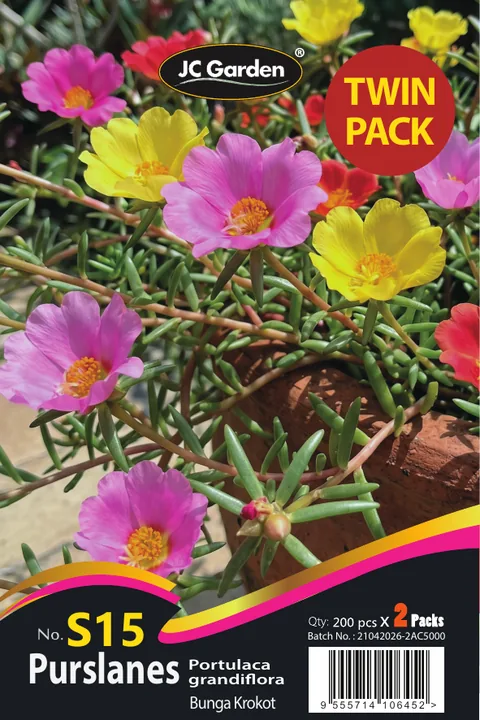
Portulaca (Moss Rose) Seeds
Drought-loving flowers for the hottest, sunniest spots — tiny seeds that need light, so sow on the surface.
Transplanting and thinning
When seedlings are about 3 cm tall with several fleshy leaves, gently lift small clumps with a spoon and move them into their final pots, about 15–20 cm apart. You can also leave a dense clump in a bowl, which quickly makes a carpet of flowers. Thin by snipping rather than pulling, so you do not disturb neighbours.
Growing from cuttings
Many Malaysian gardeners grow portulaca from cuttings, and it is very easy. Snap off a 5–8 cm stem tip, remove the lowest leaves and push it 2–3 cm into slightly damp, gritty mix. Keep it out of the hottest sun for a few days. It usually roots within 1–2 weeks. This is also the best way to keep a favourite colour, because seed from mixed plants comes up in mixed colours.
Watering in hot and rainy weather
- Hot spells: water only when the mix is dry a few centimetres down. In very shallow pots on a hot ledge that may be every day or two; in deeper pots, less often. Fleshy leaves store water.
- Rainy season: this is when portulaca suffers. Long rain makes stems soft and roots rot. Move pots under a roof if possible, never let them stand in saucers of water, and do not water while the mix is still damp.
- Water in the morning so stems dry quickly.
Feeding
Portulaca needs very little. A light liquid feed once a month during active flowering is plenty. Too much fertilizer gives leggy plants with fewer flowers.
Flowering and deadheading
Flowers come in pink, magenta, red, orange, yellow, white and bicolours, as single or rose-like double blooms. Each flower lasts about a day, but plants make new buds continuously for months. Deadheading is optional; it keeps plants tidy and can reduce self-seeding. When a plant becomes long and bare in the middle, cut it back by half or replace it with fresh cuttings.
Note: Portulaca grandiflora is an ornamental. Do not confuse it with purslane (Portulaca oleracea), the weedy relative sometimes eaten as a vegetable.
Common pests and diseases in Malaysia
- Mealybugs. White, cottony clusters on stems and in leaf joints. Wipe off with cotton dipped in diluted alcohol or spray with diluted neem oil.
- Aphids. On tender tips and buds. Spray off with water or use neem oil in the evening.
- Snails and slugs. Feed on the fleshy stems after rain. Pick off at night.
- Stem and root rot. Stems turn black and mushy at the base. Almost always too wet. Cut healthy tips to re-root in fresh, gritty mix and discard the rest.
- Leggy plants, few flowers. Not enough sun or too much fertilizer.
More organic options:
FAQ
Why are my portulaca flowers closed? They open in bright sun and close in shade, in the late afternoon, and on overcast or rainy days. Move them somewhere sunnier for more open flowers. Some newer types stay open longer.
My seeds did not come up. Why? Most often they were buried too deep, washed away by watering, or the mix dried out completely during germination. Surface-sow, press in, and mist gently.
Can I grow portulaca in a condo with only morning sun? It will grow, but flowers less and may stretch. Choose the brightest spot you have, or grow it from cuttings for a quicker show.
Does portulaca come back after flowering? In Malaysia it can keep going for many months and often self-seeds. Renewing plants from cuttings keeps them compact and flowering.