
How to Grow Morning Glory from Seed in Malaysia
How to grow morning glory in Malaysia: nicking or soaking seed, sowing, trellis, why lean soil gives more flowers, pests, and toxic seed safety.
- Difficulty
- Easy
- Days to harvest
- 60–80 days
- Updated
- 2026-11-04
Yes — morning glory (bunga seri pagi, 牵牛花) grows quickly and easily in lowland Malaysia. It is a twining climber that can cover a fence, railing or trellis in a few weeks, and usually starts flowering about 2–3 months after sowing. Each trumpet flower opens in the morning and fades by the afternoon, but new ones open almost every day. The one key tip for success: nick or soak the hard seeds before sowing so they sprout evenly. And one key safety point: morning glory seeds are toxic if eaten — keep seeds and seed pods away from children and pets.
Quick facts
| Item | Morning glory |
|---|---|
| Sun | Full sun, at least 5–6 hours |
| Sowing depth | About 1 cm, after nicking or soaking |
| Germination | 4–10 days (slower and patchier if not soaked) |
| Spacing | 15–25 cm along a trellis |
| Days to first flowers | About 60–80 |
| Container | At least 25–30 cm wide and deep, or a long planter box |
| Support | Essential: trellis, netting, strings or a railing, 1.5–2 m or more |
Safety first: toxic seeds
The seeds of ornamental morning glories contain compounds that are toxic if swallowed and can cause serious symptoms. Treat them like any other hazardous garden item:
- Store seed packets out of reach of children.
- Do not let children or pets play with the seeds or dried seed pods.
- Wash your hands after handling and nicking seeds.
- If a child or pet swallows seeds, seek medical or veterinary advice promptly.
Morning glory is a relative of kangkung and sweet potato (all are Ipomoea), but ornamental morning glory is not a vegetable — do not eat any part of it.
Choosing a spot and container
Morning glory needs sun to flower well and something to climb. A sunny balcony railing, a terrace-house fence or gate, a porch pillar wrapped with string, or a trellis against a sunny wall are all good spots. In shade it grows leaves but few flowers.
In pots, use a wide, deep container so the roots stay cool and moist — at least 25–30 cm across. A long planter box at the base of a railing works well for a green screen. Make sure there are drainage holes.
Plan the support before you sow. The vines twine around thin supports such as string, netting, wire or thin bamboo; they cannot grip a flat wall on their own.
Soil and potting mix
This is one of the few flowers that prefers lean soil. Rich soil and heavy feeding give a wall of leaves with very few flowers.
- Ordinary garden soil or plain potting mix is enough.
- Add some burnt rice husk (sekam bakar) or coarse sand for drainage.
- Skip the manure; at most mix in a small handful of compost in very poor soil.
How to sow morning glory step by step
- Nick or soak the seed. Morning glory seeds have a very hard coat. Either nick each seed carefully with a nail clipper or rub it on sandpaper until you see a pale spot (avoid the small scar where the seed was attached), or soak the seeds in warm water for 12–24 hours until they swell. Soaked seeds that have not swollen can be nicked and soaked again.
- Sow where it will grow. Morning glory dislikes root disturbance. Sow directly at the base of the trellis or in its final pot, or in deep individual pots — not in shallow trays.
- Plant about 1 cm deep, 2 seeds per spot, 15–25 cm apart.
- Water well and keep the soil moist, not soggy.
- Watch for seedlings in 4–10 days. Keep the stronger seedling at each spot.
- Guide the first tendrils. When the vines start to reach, wind them gently around the support in the direction they are already twisting.
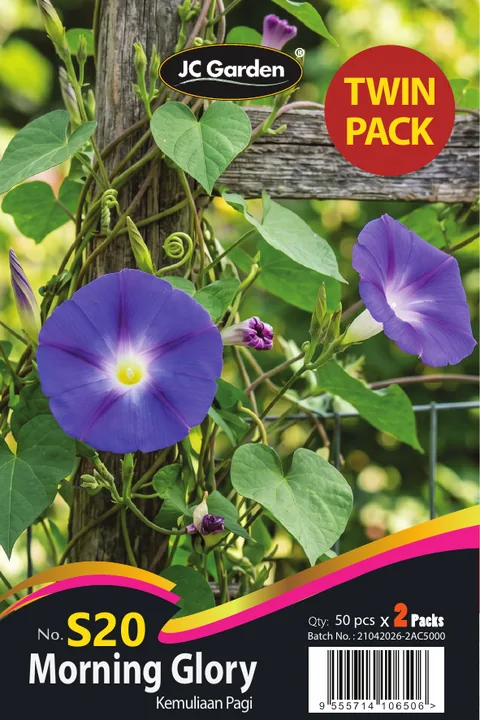
Morning Glory Seeds
Fast climbing vine for sunny railings and fences, with new trumpet flowers most mornings. Seeds are toxic.
Training the vines
Morning glory grows fast in our heat. Check every few days and tuck wandering shoots back onto the support. If you want a bushier base, pinch the tip once the vine has 4–5 leaves; it will send out side shoots.
Morning glory can self-seed heavily, and in some places it spreads beyond the garden. Remove most seed pods before they ripen and pull up unwanted seedlings, especially if your garden borders a drain, field or patch of wild ground.
Watering in hot and rainy weather
- Water when the top 2–3 cm of soil is dry. In hot spells, pots on a sunny railing may need water every morning.
- Morning glory dislikes waterlogged soil. In the rainy season, skip watering when the mix is damp and keep drainage holes clear.
- Water at the base in the morning.
Feeding
Usually very little. In plain soil, morning glory flowers best with no regular fertilizer. If leaves turn pale and growth stops in a pot that has been watered for months, give a light, half-strength liquid feed higher in potassium than nitrogen, once or twice. Avoid nitrogen-rich fertilizers.
If you need to work out a dilution:
Common pests and diseases in Malaysia
- Aphids. Clusters on young shoots and flower buds. Spray off with water, then neem oil or a mild soap solution.
- Spider mites. Speckled, dull leaves in hot, dry weather. Spray the undersides of leaves with water and neem oil.
- Caterpillars and leaf-eating beetles. Holes in leaves and rolled leaves. Hand-pick at dusk.
- Leaf miners. Pale winding tunnels in leaves. Remove affected leaves.
- Root rot. Yellowing and wilting in soggy pots. Improve drainage.
More organic fixes:
Flowering and deadheading
Flowers open early in the morning and usually close by early afternoon, especially on hot days. This is normal. You do not need to deadhead each flower, but removing the developing round seed pods keeps the vine flowering longer and limits self-seeding.
Saving seed
Leave a few pods to ripen until they turn brown and papery. Pick them, crack them open over a container, and dry the black seeds in the shade. Label the container clearly and store it out of reach of children and pets.
FAQ
My morning glory has lots of leaves but no flowers. Why? Usually too much fertilizer, rich soil or too little sun. Stop feeding, move it to a sunnier spot if possible and be patient — it often starts flowering once the vine is well established.
Why do the flowers close by the afternoon? Each flower lasts less than a day and closes earlier in hot sun. New buds open the next morning.
Can I eat morning glory like kangkung? No. They are relatives, but ornamental morning glory is not eaten, and its seeds are toxic. Grow kangkung for the kitchen:
What else grows well on a balcony railing? Our balcony guide covers sun, wind and weight on railings: