
How to Grow Cape Gooseberry (Physalis) from Seed in Malaysia
How to grow yellow cape gooseberry (Physalis, buah tanglung) in Malaysia: sowing, staking, watering, pests and when the fruit is ripe and safe to eat.
- Difficulty
- Easy
- Days to harvest
- 70–90 days
- Updated
- 2026-11-05
Yes — yellow cape gooseberry (Physalis, buah tanglung) grows in lowland Malaysia and is a fun fruit for families: sweet-tart golden berries wrapped in papery "lanterns". In good conditions the first ripe fruit comes about 70–90 days after sowing, and a healthy plant keeps cropping for months. Be aware that it prefers mild weather; in very hot spells flowering and fruit set slow down, so light afternoon shade, mulch and steady watering help. The most important rule: eat only fully ripe fruit with a dry, papery husk. Unripe green fruit, the husk and the leaves are not edible.
Quick facts
| Item | Cape gooseberry |
|---|---|
| Sun | Full sun; light afternoon shade in very hot spells |
| Sowing | Tiny seeds, 0.5 cm deep, in a seedling tray |
| Germination | Usually 7–14 days |
| Temperature | Sow 20–30°C; grows best 18–32°C |
| Spacing | 60–90 cm between plants |
| First ripe fruit | About 70–90 days after sowing; longer in very hot weather |
| Container | At least 30 cm wide and deep (about 25–30 litres), one plant per pot |
| Support | Stakes or a tomato cage; plants sprawl |
Choosing a spot and container
Give cape gooseberry a bright spot with morning sun and some relief from the harshest afternoon heat — an east-facing balcony, a terrace-house yard near a fence, or a bed that gets light shade after 3 pm. Plants become bushy and sprawling, often 60–100 cm wide, so do not squeeze them between other crops.
In containers, one plant per large pot or polybag is enough. Small pots dry out in hours on a hot balcony and the plant stops flowering.
Soil
Use a loose, well-drained mix with compost:
- 2 parts potting mix or garden soil
- 1 part compost
- 1 part burnt rice husk (sekam bakar), perlite or coarse sand
Cape gooseberry does not need very rich soil. Too much compost or nitrogen gives a huge leafy plant with few lanterns.
How to sow cape gooseberry step by step
- Fill a tray. Use a seedling tray or small pots with fine, moist seedling mix.
- Sow. The seeds are tiny. Place 2–3 seeds per cell and cover with about 0.5 cm of fine mix.
- Water gently. Mist or water from below so the seeds are not washed out.
- Keep warm and moist. Place in a bright spot sheltered from heavy rain. Seedlings usually appear in 7–14 days.
- Thin. Keep the strongest seedling in each cell and snip the others.
- Transplant. When seedlings have 4–6 leaves, move them to their final pot or bed, 60–90 cm apart. Plant slightly deeper than before, like tomatoes, and water well.
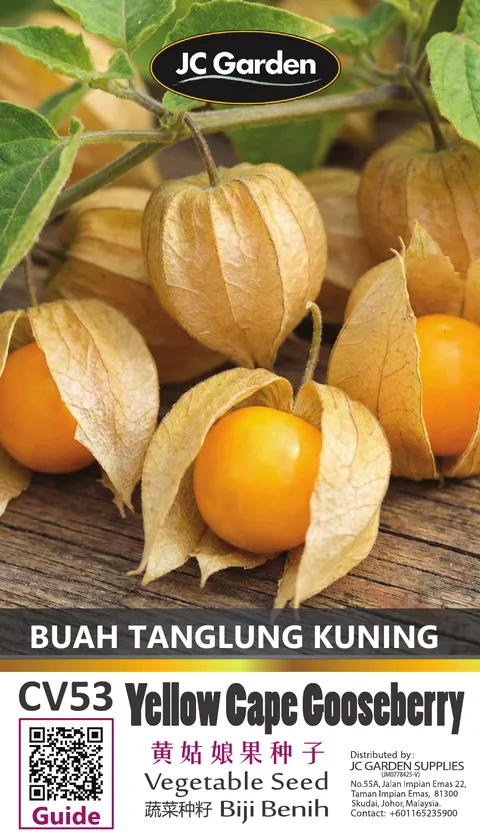
Yellow Cape Gooseberry Seeds
Sweet-tart golden berries in papery lanterns — an easy, fun fruit for pots and gardens, though plants sprawl.
Support and pruning
Put in a stake or tomato cage at transplanting. As branches grow, tie them loosely so the plant stays upright and fruit hangs off the wet soil, where it would rot or be eaten by snails.
Light pruning keeps the plant open and airy. Remove yellowing lower leaves and any branches lying on the ground. After a long cropping period, cut the plant back by about a third, then feed and water; it often produces a new flush of flowers.
Watering in hot and rainy weather
- Hot, dry spells: mulch the surface and water morning and, if needed, late afternoon. Pots may need water daily. Dry stress causes flowers and young fruit to drop.
- Rainy season: good drainage is essential; do not water when the mix is still wet. Water at the base rather than over the leaves to reduce leaf disease.
Feeding
Start light feeding about 2 weeks after transplanting, with a diluted balanced fertilizer every 2 weeks. Once flowering starts, switch to a fertilizer with more potassium to support fruit. Keep nitrogen modest.
Flowering and pollination
The small yellow, bell-shaped flowers usually pollinate themselves, helped by wind and insects. Each flower that sets fruit forms a green lantern around the berry. In the hottest months you may see flowers drop without setting fruit; this usually improves when the weather cools slightly. Gently shaking flowering branches in the morning can help.
Common pests and problems in Malaysia
- Whiteflies and aphids. Sticky leaves and tiny insects under the leaves. Spray with water, then neem oil or a mild soap solution, covering the undersides.
- Spider mites. Fine yellow speckling in hot, dry weather. Spray the undersides of leaves with water.
- Caterpillars and leaf beetles. Holes in leaves and husks. Pick off by hand in the evening.
- Snails and slugs. Damage to low fruit after rain. Keep fruit off the soil and remove pests at night.
- Leaf spots. Brown spots during long wet spells. Remove affected leaves and improve airflow.
- Wilting and root rot. Sudden wilting in waterlogged soil, or wilting that does not recover in the evening, which can be bacterial wilt. Remove badly affected plants and do not replant related crops such as tomato, chilli or brinjal in the same soil straight away.
Harvesting
The fruit is ripe when the husk turns dry, papery and straw-coloured, and the berry inside is golden-orange. Ripe fruits often drop on their own, so check under the plant every day or two. Do not pick green lanterns hoping they will ripen; unripe fruit should not be eaten.
Remove the husk before eating. Ripe fruit left in its husk keeps for a while in a cool, dry spot.
FAQ
Is cape gooseberry the same as the wild letup-letup weed? They are related Physalis plants with similar lanterns, but the yellow cape gooseberry gives larger, sweeter fruit. Do not eat wild plants unless you are sure what they are.
Why are my plants flowering but not fruiting? Usually heat or dry stress. Give light afternoon shade, mulch and water regularly; fruit set often improves in cooler months.
Can I grow it on a condo balcony? Yes, in a large pot with at least 5–6 hours of sun and a cage for support.
What grows well alongside it? Tomato needs similar care, so the two make a good pair: