
How to Grow Spinach in Malaysia (An Honest Guide for Lowland Gardens)
Can true spinach grow in lowland Malaysia? Best months, pre-chilling seeds, afternoon shade, rain shelter, pests and harvesting young leaves.
- Difficulty
- Harder
- Days to harvest
- 35–50 days
- Updated
- 2026-11-05
Honest answer: true spinach (Spinacia oleracea, the broad-leaved, dark green plant on our pack) is a cool-weather crop, and it is hard to grow in lowland Malaysia. It germinates poorly in hot soil, grows slowly in steady 30 °C+ heat, and tends to bolt — shoot up a flower stalk and turn bitter — before it gets big. Most spinach sold in Malaysian supermarkets comes from the highlands or is imported. In the lowlands it can still work if you sow in the slightly cooler months (roughly November to February), give it afternoon shade and rain shelter, and harvest the leaves young, about 35–50 days from sowing. The one key tip: keep the plant cool and growing without stress, and pick early rather than waiting for big plants. If you want an easy, heat-loving "spinach" for everyday cooking, bayam or kangkung are far better choices — see the links at the end.
Quick facts
| Item | Spinach |
|---|---|
| Sun | Morning sun, 4–5 hours; shade from about 12 pm onwards in the lowlands |
| Sowing depth | 1–1.5 cm |
| Germination | 5–14 days; slower and patchier in hot weather |
| Spacing | 10–15 cm between plants (8 cm if harvesting as baby leaves) |
| Days to harvest | Baby leaves from about 30–35 days; larger leaves 40–50 days |
| Container | Trough or pot at least 15–20 cm deep |
| Support | None needed |
Is this the same as bayam?
No. In Malaysia "bayam" usually means amaranth, the green or red leafy vegetable that loves heat. "Spinach" here means true spinach, a different plant from cooler climates. Our pack says "Bayam Spinach" to make that clear. Malabar spinach (the climbing vine with thick, glossy leaves) and Brazilian spinach are also different plants, and both cope with lowland heat much better than true spinach.
Choosing a spot and container
Spinach wants bright light but not harsh afternoon sun. On a condo balcony, an east-facing spot with morning sun is ideal. In a terrace-house yard, place pots where a wall, a taller plant or a shade net (around 30–50%) blocks the sun after midday. Avoid spots next to air-conditioner compressors or hot concrete walls that radiate heat in the evening.
Use a wide trough, styrofoam box or several 20–25 cm pots with good drainage holes. Containers are actually an advantage: you can move them into shade during a heatwave and under the roof during heavy rain.
Soil and potting mix
Spinach likes loose, rich, moisture-holding soil that is not acidic. Many Malaysian garden soils are acidic, which spinach dislikes. A good mix:
- 2 parts potting mix or loose garden soil
- 1 part compost or well-rotted manure
- 1 part cocopeat or burnt rice husk (sekam bakar)
- A small handful of dolomite lime per large pot, mixed in a week or two before sowing
Make sure the container drains freely. Waterlogged roots rot quickly in warm weather.
How to sow spinach step by step
- Pick your timing. Sow from about November to February, when nights are a little cooler. Avoid the hottest, driest stretches of the year.
- Pre-chill the seeds (optional but helpful). Soak the seeds in water for 12–24 hours, then wrap them in a damp paper towel inside a container and keep them in the fridge (not the freezer) for 3–5 days. This often helps germination when the soil is warm.
- Prepare the container. Fill it with moist mix and water well. Keep the filled container in the shade for a day so the soil is cool.
- Sow. Make holes or a shallow furrow 1–1.5 cm deep and drop seeds about 5 cm apart.
- Cover and firm. Cover with mix, press gently, and water with a fine rose.
- Keep cool and moist. Keep the container in bright shade until seedlings appear, usually 5–14 days. A layer of damp newspaper or sacking over the soil helps keep it cool; remove it as soon as the first shoots show.
- Bring into morning sun once the seedlings are up, and keep afternoon shade.
You can also sow in seedling trays in a cool, shaded spot and transplant when seedlings have 3–4 true leaves. Move them gently — spinach dislikes root disturbance.
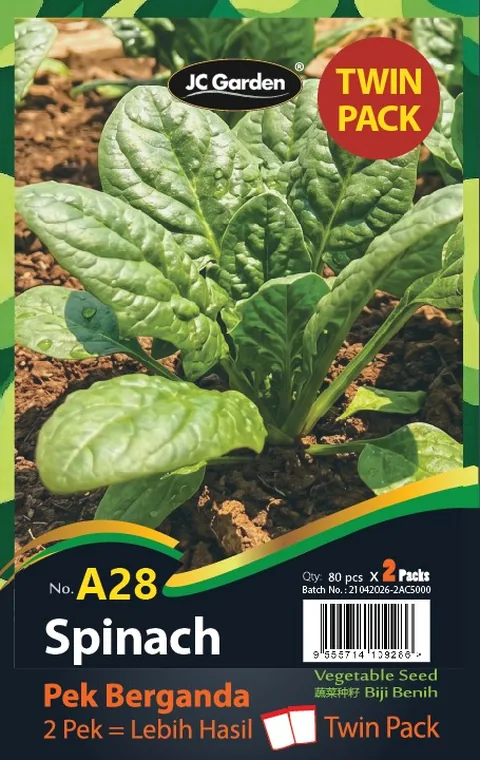
Spinach Seeds
JC Garden seed twin pack (2 packets). See the pack for sowing details.
Thinning
Thin seedlings to 10–15 cm apart once they have 2–3 true leaves. Crowded spinach stays small, holds humidity around the leaves and is more prone to leaf disease. The thinnings are edible as tiny salad greens.
Watering in hot and rainy weather
- Hot spells: water in the early morning so the mix stays evenly moist. Check again in the late afternoon; dry soil is a common trigger for bolting. A thin mulch of dried leaves or straw helps keep roots cool.
- Rainy weather: heavy rain splashes soil onto leaves and spreads disease. Move pots under the eaves or a clear roof, and never let them stand in water.
- Water at the base, not over the leaves, and avoid watering late in the evening so leaves are dry overnight.
Feeding
Spinach is a leafy crop and needs steady nitrogen to keep growing before the heat stops it.
- Mix compost into the potting mix at sowing.
- From about two weeks after germination, feed with a liquid fertilizer every 7–10 days at the dilution on the label.
- Go easy: overfeeding with strong fertilizer in hot weather can scorch roots. Little and often is safer.
Bolting: what to expect
In the lowlands, some plants will bolt early, no matter what you do. Signs: the centre of the plant stretches upward, leaves become narrower and pointed, and a flower stalk appears. Once that happens, the leaves soon turn bitter. Harvest the whole plant straight away and sow again. Shade, cool roots, steady water and harvesting young are your best defences.
Common problems and pests in Malaysia
- Damping off. Seedlings collapse at soil level. Use fresh, clean mix, do not overwater, and give seedlings airflow.
- Leaf spots and downy mildew. Yellow patches on top of leaves with grey-purple fuzz underneath, or brown spots. Common in humid, rainy weather. Remove affected leaves, space plants wider, keep rain off and water only at the base.
- Leaf miners. Pale, winding trails inside the leaves. Pick off affected leaves and check the undersides for tiny eggs.
- Caterpillars and aphids. Hand-pick caterpillars; wash aphids off with water or spray diluted neem oil in the evening, covering the undersides of leaves.
- Snails and slugs. Active after rain. Pick them off at night with a torch.
- Pale, slow plants. Often acidic soil or hunger. Check that you added dolomite lime and feed regularly.
Harvesting
Harvest young. Start picking the outer leaves once the plant has 5–6 good leaves, usually from about 30–35 days, and leave the centre to keep growing. Pick in the morning when leaves are crisp. In lowland heat it is better to take several small harvests than to wait for one big plant that bolts. When the plant starts to stretch, pull it whole.
FAQ
Why did my spinach seeds not germinate? Warm soil is the most common reason. Sow in cooler months, pre-chill soaked seeds in the fridge for a few days, and keep the container in shade until seedlings appear.
Can I grow spinach on a balcony? Yes, and a balcony with only morning sun can actually suit spinach better than a full-sun yard. Keep it out of hot afternoon sun.
Will spinach grow better in the highlands? Yes. Spinach is much easier in cool highland areas. In the lowlands, treat it as a seasonal experiment and harvest small.
What can I grow instead in the hot months? Choose a heat-loving leafy green. Bayam (amaranth) and kangkung grow fast in Malaysian heat and are cooked in the same ways: